



Podcast: Play in new window | Download
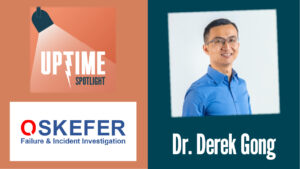
Derek Gong from Oskefer Consulting, joins to discuss drivetrain failures, OEM handoff gaps, and missed SCADA warnings. Reach out to Derek on LinkedIn.
The Uptime Wind Energy Podcast is brought to you by Weather Guard Lightning Tech, creators of the StrikeTape Ultra LPS retrofit. Subscribe to Uptime’s Substack newsletter. And check out Rosemary’s “Engineering with Rosie” Youtube channel. Have a question we can answer on the show? Email us!
Episode Transcript
Welcome to Uptime Spotlight, shining light on wind energy’s brightest innovators. This is the progress powering tomorrow.
Allen Hall: You’re based in Singapore, you’re a subject matter expert in drivetrains, and you cover a large portion of Southeast Asia, which I’m fascinated by because I know there’s a lot of wind activity in that region. So you’re the expert, I’m the novice, and I want to learn some things from you today. What is happening to wind turbine drivetrains in Southeast Asia? It just seems like a unique environment with some really specific challenges.
Derek Gong: Yes. Pretty much, I think the wind industry in Southeast Asia follows the steps of the US and Europe. But one unique thing we see is that we have a much younger fleet, and we have a mix of OEMs. Historically, the OEMs came from the US or Europe, but in recent years we also have Chinese OEMs. So we have a mix of fleets. One thing we see is that the Asian market still has insufficient trained technicians for maintenance, and that actually causes us to see more drivetrain issues in this part of the world.
Allen Hall: Are there a lot of differences between a European drivetrain and a Chinese-manufactured drivetrain in terms of the concept at the top level, or are they pretty much the same?
Derek Gong: In terms of the design, they are pretty similar to the European ones. If you look at the drivetrain system, the bearings and main shaft are still supplied from similar OEMs, so for that part it’s pretty much the same. But if you look closer at the components, they may use some newer suppliers, such as bearing suppliers. Historically in Europe, you had two or three suppliers in the market. But if you look at the subsystem suppliers in Asia, we’re talking about many, many more. Those suppliers historically manufactured bearings for other systems, like cars, and they redeployed that technology to start manufacturing components for the wind industry. You can borrow a lot of the technology, and you can also borrow the process, but it’s not exactly the same. So you can see a few more issues, especially when new suppliers come into the market.
Allen Hall: Oh wow. Okay. So they have slightly different approaches to basically the same components. The overall structure is the same: there’s a main bearing, there’s the main shaft, there’s the gearbox. But the sub-tier suppliers may be completely different. The supplier base may be significantly different depending on their expertise in delivering components. So when decisions are made to purchase wind turbines in Vietnam or Cambodia or the Philippines, are they taking some of that into consideration when they’re selecting turbines? Or is it an overall price and power output comparison?
Derek Gong: We can see a change in the trends from earlier years. If we talk about ten years ago, the market was still dominated by the European and US OEMs.
Allen Hall: Okay, that makes a lot of sense. I know that discussion is happening globally at the minute, with Chinese OEMs offering typically 30% to 40% lower prices for turbines per megawatt. But when you do that, you may get a different supply chain versus a European or an American manufacturer. As a subject matter expert, does that change how you approach a drivetrain? Do they have different failures or different tendencies because of the construction and the different suppliers?
Derek Gong: I think there is no clear pattern. Even for us, when we look at the different OEMs, I would say there’s no significant difference showing that one OEM’s failure rate is much higher than another’s. But you may expect to see different failure modes. For some, it’s more materials or manufacturing issues, and for some it’s more about design maturity. But overall in Asia, what we see more is maintenance-related.
Allen Hall: Wow. Okay.
Derek Gong: And it comes back again to the price point. For most wind farms, for the first five years after they’re developed, they enter into a long-term service agreement with the OEM, so the OEM helps them maintain the turbines, no matter whether it’s European, US, or Chinese. The trend I see is that after five years, when that first contract ends, they go to a local contractor, whether in Vietnam, Thailand, or the Philippines. They think that because they’ve learned for five years, they can maintain the turbines well. But from what I see, there are still gaps in terms of experience and good maintenance practice. So we see quite a lot of cases that are really related to maintenance issues.
Allen Hall: Okay, that’s a very interesting insight, the transition from the OEM full service agreement to basically self-maintenance. Is there a handoff that happens? I see it with operators in the United States quite often, where they were under a full service agreement, that agreement ends, and the manufacturer just leaves. There’s no real handoff to the local company to run the turbines. There does seem to be a knowledge transfer that never really occurs. Are you seeing the same thing in Southeast Asia?
Derek Gong: Certainly there is a handoff process for the transition from the OEM to the local contractor. But I would call it a paper handover. You have a process, but the knowledge cannot be transferred within a single day or a few months. That knowledge was built over several decades.
Allen Hall: That’s interesting. So it’s much like many places. Australia and even parts of Europe have the same issue. If you’re new to wind, during those first several years you just don’t have the supply base or the knowledge base locally to understand the maintenance requirements unless they’re written down. I think most operators are trying to be good operators and will checklist all the oil changes and grease changes. Those things do seem to happen, but it’s all the non-obvious maintenance that the OEM knows about. Does that just take time, or is there a better way to transfer that information and stand up the local support systems?
Derek Gong: Certainly it takes time to learn. I would say the OEMs generally did a very good job training up the local workforce, especially in the first few years, when they hire local technicians and train them. It doesn’t happen immediately, but I can see the quality improve year by year. Still, when I’m doing an investigation, I always encourage them to go back and ask the OEM for input on the system design. What’s the design intent?
Allen Hall: That’s true. If you don’t understand the design intent, a lot of times it’s not obvious, particularly on drivetrains, what exactly is supposed to happen in the setup, the configuration, and the maintenance. That’s especially true when you’re dealing with several OEMs with a variety of different approaches. Southeast Asia, I think, offers some really complex weather. The terrain can be difficult, and wind turbines are installed in remote locations. That can turn into a significant problem if they’re having drivetrain or gearbox problems. It gets expensive fast, right?
Derek Gong: Yes, we’re in a unique position. Every year in the Philippines, we have five or six typhoons. And I think this region has some of the highest lightning strike intensity. Everybody thinks lightning strikes are going to impact the blades, but they can actually affect your drivetrain system as well. I can share an example. We had a particular wind farm, only two to three years into service, with multiple main bearing failures. People said it’s just a bad bearing, very bad quality, maybe the heat treatment didn’t meet the specification. But when we dove deeper and compared units with the same OEM and the same design, we found that what was different from unit to unit was actually a problem with the grounding system. That caused stray current to discharge into the bearing and damage it. So I would say it’s a maintenance issue.
Allen Hall: Having been in the lightning business for a long time, Southeast Asia is one of those places where the lightning strikes are just different in a number of ways, especially when severe weather comes through: the number of lightning events, and sometimes the duration of the event. How long it lasts can drive a significant amount of energy into the bearings, and it’s amazing how much damage that can cause. You see it on aircraft engines all the time, but you wouldn’t think a wind turbine, as big and massive as it is, would have that same issue. But you’re seeing that pretty frequently in Southeast Asia?
Derek Gong: Yes. I would say a lot of the time, these issues can be resolved by good maintenance practice. It takes time to learn, but with education, it’s something that can improve. Very simple maintenance practices can reduce very simple maintenance errors.
Allen Hall: This is fascinating. I’m learning a lot already. What are some of the other environmental factors that play into drivetrain issues? Vietnam and the Philippines are hot, the humidity can be quite high, and there’s a good bit of salt in the air. Do those affect drivetrain lifetime? Do you see shortened lifetimes because of that?
Derek Gong: We do have issues with that. You’re right, it’s typically a tropical climate, and most wind farms are built quite near the shore, where the wind is stronger. So we have a lot of corrosion issues from the salt. And the biggest problem comes during shutdown periods. If the turbines are running, you may not have much of a problem, because they warm up and you won’t have condensation issues. But we have some cases where turbines are shut down for a period of time without much protection. It’s very warm, you get condensation inside, and corrosion can happen. Several wind farms have been quite badly affected.
Allen Hall: Because of the shutdown, the humidity must increase in the nacelle. It just becomes wet and you get corrosion, then you start spinning all those metal components and creating debris in the grease and the lubrication systems. It won’t take long to have an effect on the drivetrain. Are there ways to reduce that besides running the turbine all the time?
Derek Gong: We have some systems affected by typhoons that are waiting for repair. We basically advise the operators to keep some air circulating to dry it out, with a bit of ventilation, so it’s not entirely covered or closed. A lot of people think that if you have damage, covering it up very tightly is good practice. It is not. You want a bit of ventilation, and you put in a drying agent like desiccant to remove the moisture in that area.
Allen Hall: That wouldn’t be obvious, but now that you say it, it makes a tremendous amount of sense. So what kinds of failures are you typically seeing in Southeast Asia when it comes to drivetrains? In the United States, and what I’ve seen globally, it’s main bearings, pitch bearings, anything toward the blade end that’s really susceptible. As you get closer to the generator, it’s probably a more controlled environment. Do you see the same sort of things?
Derek Gong: I think the majority is still the main shaft bearing.
Allen Hall: Really?
Derek Gong: The majority, because we have a few OEMs with fleet issues on the main bearings, and that affects the numbers quite a lot. But we also still have quite a lot of gearbox issues.
Allen Hall: Is that due to capacity factor, how hard they run them, which increases the aging? Or is it other factors, like humidity, or water in the lubrication systems? What’s driving some of that acceleration?
Derek Gong: First, for the bearing system, as I mentioned, there are maintenance issues such as the grounding brushes and other electrical factors. Another major factor is grease contamination, which can be an environmental issue. We also have problems with lubrication. In Europe and the US, they closely monitor the metal particles from the systems. Over the years I can see an improvement in the practice here, but it’s probably still behind the US or Europe. The site people, especially the site engineers, probably still lack the knowledge.
Allen Hall: You know, there does seem to be a tremendous amount of science in lubrication. It’s complicated and not obvious. You can put any oil or grease between your fingers and yes, it’s lubrication, but all the little ingredients inside it decay over time, and there’s a need to refresh it. Does it just come down to simple maintenance, which is not simple, by the way? There’s a lot of science behind some of these things we take for granted as engineers. Or is it that some turbines are located in remote places, which makes it harder to maintain them at the level they probably need?
Derek Gong: Yes, I think that’s quite true in Asia. Generally in Asia, they build on mountainous terrain. Even installation is very difficult in terms of transportation and cranes. Sometimes replacing one main shaft bearing means mobilizing several cranes, and it’s very costly. So sometimes they probably delay the maintenance schedule.
Allen Hall: Wow. Okay. That makes sense. Globally, when turbines are out on some hillside or near the shoreline, the maintenance workers don’t tend to live close, so it’s hard to get out on site all the time. It’s one of the problems with siting wind turbines. The good winds aren’t necessarily near good population centers. Now, you’re involved in a number of things: root cause analysis, evaluating turbine health, and looking at it from an insurance perspective to understand the driving factors. Do you get called in quite often to look at drivetrain issues, and what do you generally get called in for? Is it catastrophic conditions, or more poor performance that an operator would be concerned about?
Derek Gong: Generally there’s not a strong incentive for operators to call us, so most of the time it’s catastrophic failures. In my work, we actually do two types of work. We work for the operators, and we also work for the insurance companies. Most of the time, the failure has already happened and they cannot operate the turbine, so they want to claim on their insurance. We have to go there and look at what exactly happened and why.
Allen Hall: Those investigations must involve a lot of metallurgy and understanding of the systems. Are you pulling grease or lubrication samples, or pulling bearings and deconstructing them to determine the failure mode?
Derek Gong: Yes. Over the years it has become a more systematic approach. For the major parts, we rely on the operators to dismantle them, and we attend the dismantling to look at the evidence, collect grease samples, and do metallurgical sectioning of the bearings. We also look at the CMS, the condition monitoring trends, and the SCADA data. And we look at the maintenance records for several years. Generally we take an evidence-based approach. We use the evidence to reach a conclusion, rather than saying, “I’m a very experienced guy, and my gut feeling says this is the reason.” Because of my background, I tend to use a more systematic approach.
Allen Hall: I’m curious now. You mentioned SCADA data. With a drivetrain in particular, are there early signs an operator could have detected if they had been looking at the detailed SCADA data, not just the alarms but the underlying sensor data? Will it give you a lifetime or health assessment for your turbine?
Derek Gong: In the cases I’ve seen, there’s quite a lot of information. If I export the data and ask my engineer to perform an analysis, we can get a lot of useful information. We can see that six months or a year ago, the bearing already gave you some indication. But if you talk to the site operators, they say, “No, we already looked at it.” Sometimes there’s one alarm on a bearing. You can see the vibration keep going up, keep going up, keep going up. But as long as it didn’t reach the alarm level, they say, “I can just operate it because it didn’t reach the alarm.” That’s a kind of reactive approach. You’re right that the CMS system is very sophisticated, and you can get a lot of useful insight out of it, but unfortunately you cannot rely on the site engineers to look at that. You must have a back-end engineering specialist look at that data.
Allen Hall: Yeah. I think a lot of operators are learning that lesson the hard way, with remote operations centers and the amount of data they can pull off SCADA systems, if they’re allowed to access them. They’re learning a lot of lessons from RCAs and expert opinions, just like you were saying: the trend lines were there six months ago. All you need to do is watch this curve, watch this vibration line, and it’ll tell you that you need to shut down, or maybe start derating that turbine to extend its life until you can do a repair. It’s surprising that operators don’t do it. But when I talk to operators and they start going through the SCADA data, there are infinite amounts of data. Infinite. I understand now that it’s a really difficult thing to do. If you’re not looking at that particular sensor on that particular day, you may not see it. My question is, do advances in AI systems and their ability to scan tremendous amounts of data change how we approach wind turbines, and particularly drivetrains? Can we start monitoring some of these things?
Derek Gong: Personally, I very much welcome that development in the industry. I think it’s still quite a new area. I do hope someone can really develop solutions that simplify the insights and get them to the operator.
Allen Hall: It does seem like a market opportunity to offer that service, and I know a number of companies are trying to do that right now. What I think they’re missing are experts like you. You still need a smart person with experience to help diagnose, to be that doctor. So if you’re mostly getting called in after catastrophic events, are operators starting to get smarter and realizing maybe they need you to come once a year, look around, and make sure their turbines are operating the way they think they are? It does seem like your expertise could be used in a lot of different ways.
Derek Gong: Certainly. On a few occasions we have given advice to operators after the first catastrophic failure. I think operators should appreciate that they need different expertise beyond daily routine maintenance.
Allen Hall: So you can give them advice that if they just do these additional maintenance items, their risk will drop dramatically. Is that where it goes in terms of advice to operators?
Derek Gong: After the project is finished, we help them review ongoing monitoring data to see whether a similar issue is going to repeat, or whether the problem has been resolved.
Allen Hall: Right. Because if they’ve had an issue with one turbine, they probably have an issue with most turbines. If the root cause is similar, it should be almost everywhere. That’s fascinating, because I see Southeast Asia as a huge growth market for wind. Obviously you have the Europeans and the Chinese, and there’s kind of a battle going on there, so there are a lot of decisions to be made. Operations-wise, I think you’re right. It does take time for local companies to gain the expertise. That’s why you’re so valuable to this discussion, to keep these wind turbines up and running. They become important parts of the grid in a lot of countries. What’s likely to happen over the next couple of years? Where are you headed? Are you thinking about giving more of that kind of expert advice to operators to improve their maintenance systems and recognize failures earlier in the lifetimes of these turbines?
Derek Gong: Yes, certainly. That’s one area of our development. I think the market generally lacks third-party expertise. Apart from us, there are other consulting firms starting to do that kind of work. But we don’t really have a conflict of interest. If the OEMs have an issue with the design, they probably don’t want to see it. And if it’s an operational or maintenance error, the operators don’t want to admit it. It’s just human nature. So we see the value in bringing in third-party consultants to bridge that gap.
Allen Hall: That’s why you are where you are. You’re based in Singapore, so you’re really close to a number of different wind farms, just a flight away from a lot of really interesting wind farms. Derek, this is a great discussion. I find it fascinating, because when we talk to experts around the world, they have such good input. I’m always so proud when we talk to wind turbine people, because they’re so knowledgeable about the industry. They understand what the difficulties are, and they’re bringing their expertise to the world, which is what this podcast is about. You’re contributing to that global knowledge, and I appreciate you for doing that. There are a lot of operators in Southeast Asia who could use your help. How do they get hold of you? What’s the best way to reach you?
Derek Gong: I’m quite a heavy user of LinkedIn. But actually, most of the time they get our contact through insurance.
Allen Hall: Oh, really?
Derek Gong: You may be surprised, but most wind farms have an insurance program. When they have issues, sometimes insurance-related, they reach out to their brokers or insurance company and say, “I need an expert to help me with that.” So we get a lot of calls through that channel.
Allen Hall: So obviously you’re available on LinkedIn, and we’ll put your LinkedIn link in the show notes. What’s the website they can go to find you?
Derek Gong: Oh, yes. Oskefer.com is our company website. I think this podcast is helping a lot of people doing that job.
Allen Hall: So the website is oskefer.com. They’re based in Singapore, and Oskefer has a number of experts working for the company. So if you have wind turbine problems in Southeast Asia, or even in Australia, they’re a great resource. A lot of insurance companies use them for their expertise. Derek, it’s been great to have you on the podcast. I really appreciate all the knowledge, and thank you for joining us.
Derek Gong: Thank you.