



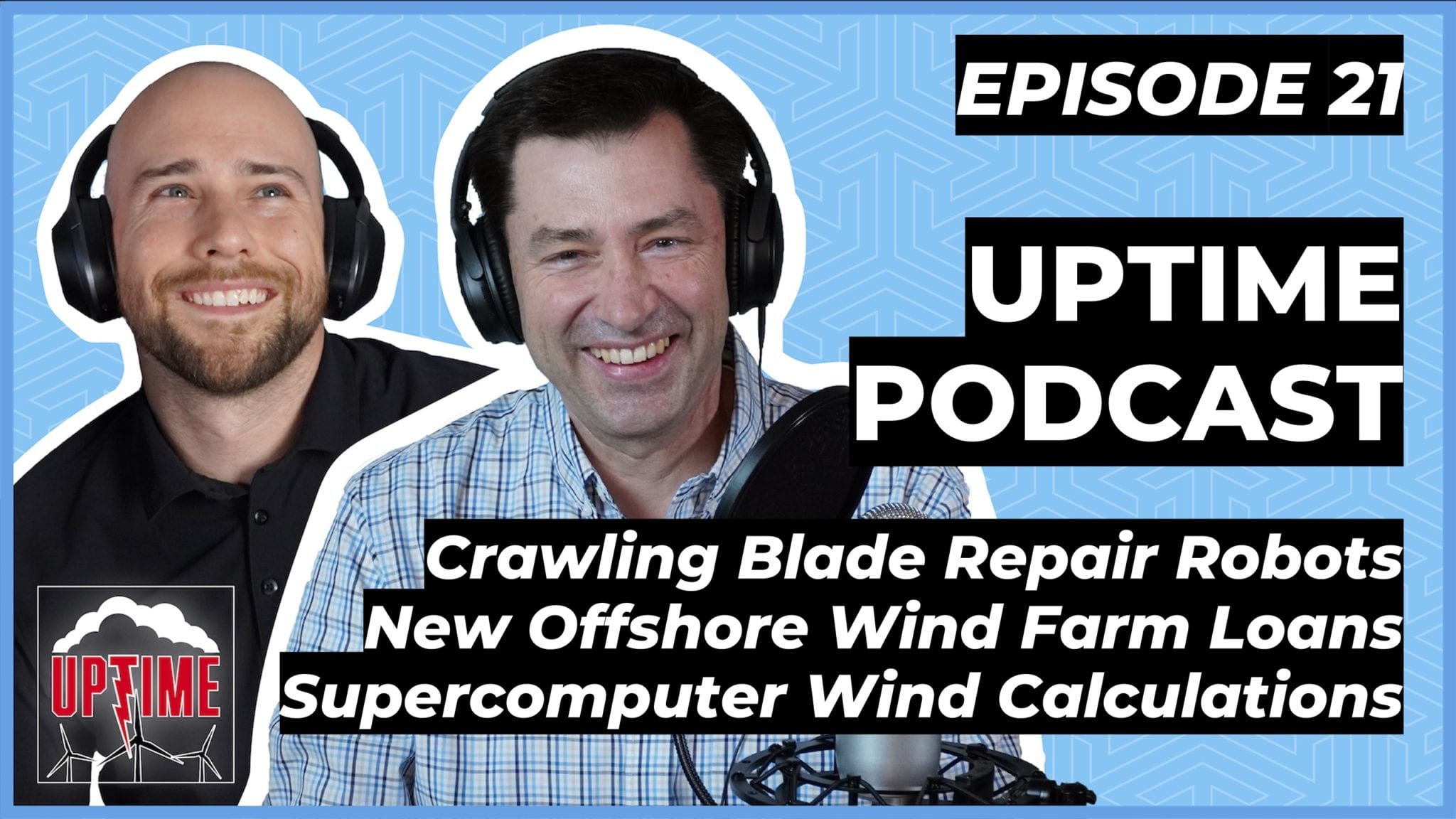
In this episode of the uptime podcast, we discuss crawling wind turbine blade repair robots and how supercomputers are being used to calculate wind jets offshore to optimize placement of turbines. Lastly, floating wind turbine farms are getting a boost with new loan options.
Learn more about Weather Guard Lightning Tech’s StrikeTape Wind Turbine LPS retrofit. Follow the show on YouTube, Twitter, Linkedin and visit Weather Guard on the web. Have a question we can answer on the Uptime Wind Energy Podcast? Email us!
Podcast: Play in new window | Download
Full Transcript: EP21 Crawling Repair Robots and Supercomputer Wind Calculations Plus Better Offshore Wind Farm Financing
Dan Blewett: This episode is brought to you by Weather Guard Lightning Tech. At Weather Guard, we make wind turbine lightning protection easy. If you’re a wind farm operator, stop settling for damaged turbine blades and constant downtime. Get your uptime back with our strike table lightning protection system. Learn more in today’s show notes or visit dot com slash strike tape.
Allen Hall: Welcome back I’m Allen hall.
Dan Blewett: I’m Dan Blewett. And this is the uptime podcast where we talk about wind energy engineering, lightning protection, and ways to keep your wind turbines running.
All right, welcome back. This is uptime episode 21. And on today’s show, we’ve got a bunch of great topics for you. First off, we’re going to talk a little bit about financing for offshore wind. So there’s a, a new type of loan that’s become common on with onshore wind farms, but it looks like it might become viable soon for offshore.
So is exciting. We’ll talk a little bit about hydrogen. Um, Jeremy’s got some things in the works. Uh, GE is also using. Supercomputers to figure out air flow, some of these complex, um, just types of circulation out there in the ocean. Pretty interesting. So they can kind of predict what some of these off shore sites, um, what they might yield.
And then we’re also going to talk a little bit about crawling robots, flying drones, some new technology in. Uh, when blade, uh, damage detection. And lastly, there’s a pretty interesting paper on leading edge erosion that we’re going to cover a lot of really interesting takeaways from that.
Allen Hall: A lot of exciting things in, in wind news this week.
Uh, w what I really want to talk about that G supercomputer, cause I think that’s a cool technology, but let’s start off with the offshore wind and the financing you want to describe that a little bit deeper?
Dan Blewett: Yeah. Yeah. So non-recourse loans could really lower. Wind energies fixed costs. And it’s suddenly, this is basically in, I guess, unsecured isn’t exactly the right word, but on leveraged loan, is that how you interpret this?
Allen Hall: Right? Uh, would be like, uh, getting a mortgage on your house, but they can’t come take the house if you don’t make it the payments.
Dan Blewett: Yeah. So it sounds like it’s basically secured by the, by the future profits. So, um, pretty interesting that I guess lenders are starting to feel like the offshore floating technology.
Is, you know, to the point where it’s, I guess, maturing where they feel comfortable that, Hey, this is not going to just topple over. And our investment will be gone. Cause if we can’t take the physical assets, then we have nothing. Like they need this to keep running, to get paid. But that sounds interesting that if the markets getting there that these non-recourse loans will.
Tensley paved the way for a lot of offshore floating wind farms.
Allen Hall: It will, is there getting confidence in the ability of those off shore sites to produce energy, even late in the lifetime, which is what it’s all about. Then the risk goes way, way down. So it’d be like investing in a slot machine. Right. The slot machine is going to put out, put out, put up, put out, no matter what you do.
As long as the slot machine doesn’t break, it’ll always be producing revenue for you sorta works like that. Like you don’t actually own the slot machine. You want a percentage of the outcome of the slot machine, but you help finance the slot machine. I’m not a bad investment as long as the slot machine doesn’t break.
And in this case, as we’re talking about later today, The offshore wind turbine performance is not necessarily guaranteed. So this is going to be in conflict, right? Having a, a non-recourse financial situation is going to be based upon the wind term has continued to produce at some reasonable level at years, 15, 16, 17, 18, 1920.
Plus, how do you get there? And are, are the designs we have. Or coming out of the factory today, gonna be able to do that. Um, so there’s a bunch of dispute about that right now. It’s some really interesting papers coming out in the last month or two discussing those, uh, outcomes. So,
Dan Blewett: yeah. And of course, yeah.
And this is an article from Greentech media. Um, good reporting from Jason Dane, but. I mean, yeah, I mean, they say like this isn’t, this isn’t brand new technology, the floating wind turbines, like they’re stealing from oil and gas. Like they’re not reinventing the wheel. They’re saying, Hey, we’ve been doing this for a long time off shore.
How can we apply this to win? So it’s, it’s quickly maturing, which again, makes sense. They’ve been doing solely this way out there in the, in the open ocean for a long time. So it sounds like
Allen Hall: what’s your worst case on an offshore wind turbine. It sinks right. Falls over that’s that’s your worst case and that situation, and
Dan Blewett: you don’t have dolphin attack.
They’re like, get this, get this out, get this out of our ocean. This doesn’t belong here. Yeah.
Allen Hall: Flipper goes crazy.
Dan Blewett: Yeah, exactly. But no, I mean, uh, it’s interesting to, to forecast for like what the. The worst possible, you know, waves would be like with a crazy storm. Cause you, I mean, you’ve seen some of the, like the deep sea fishing.
I mean, those are intense to think that a, a winter I could float and conditions like that seems crazy. But then again, you see these oil and gas rigs out there and they’re still. They’re out there. They don’t go under. So just like the Testament to the engineering, it’s pretty, it’s pretty incredible.
Allen Hall: It is.
And even the, the tsunami situation, which I think is in my head has always been the worst case when you got to wave sucks, all the water out and it pushes all the water back at ya. Uh, you know, designing against things like that. It’s crazy. I’m not sure winter was the floating wind turbines going to be able to handle that.
Kind of situation. So that’s one of the things about off coast of Japan, because that’s where a lot of tsunami activity happens. But, uh, you know, in every, in everybody’s mind change to get to a financial situation that stable, essentially that turbine installation cannot go away and any possible circumstances, just the downside risk would be huge there.
So it seems like we’re getting to the point though. And evolving engineering wise to a stable situation, which is good, which is where we should be at this point.
Dan Blewett: Yeah. So some news out of Germany, this article is via renews.biz. Uh, Germany’s backing the green hydrogen team. So they’re trying to, obviously along with everyone to slowly decarbonize over time, I guess maybe slowly is not the word, but just trying to get there, I guess, as soon as we can, which is still five, 10, 15 years away.
Right. But, um, They’re really going hard after hydrogen. And you know, this project would, I mean, it looks, sounds like it gets pretty involved as far as, you know, just like the funding that they require. There’s just a lot of investment there’s it seems like there’s a lot going on, but they’re going to produce screen hydrogen, transport.
It have their own gas network, you know, and it’ll be used in industrial processes and a lot of different things. So what is, what does this mean here?
Allen Hall: Well, I want to know what green hydrogen even means. If there’s green, hydrogen, are there other colors of hydrogen? I don’t understand that terminology because it just seems like hydrogen only one possible solution for hydrogen, uh, is going to be discussed.
And I’m not. I don’t know if that’s the right answer, either. Obviously things evolve over time. And if we can, I know we can remove hydrogen from essentially fossil fuels today too. And it’s a much more efficient method to do it. Uh, if that gets us to the situation where we can get to electrolysis or essentially, you know, taking water and breaking apart into hydrogen and oxygen.
That process will take us longer to get to. So what do you want to, do you want to continue to burn diesel fuel until you get to green hydrogen? Or do you want to get to hydrogen? Cause I think the answer is to get to hydrogen first and then worry about the green secondarily, but that’s not. Sometimes whether the European consortium’s go, where they go for the, the big thing.
And then just like Germany has gone through recently where they have devolved back into a lot of coal, um, and shut down some nuclear sites. I’m not sure if that made any sense either. So, uh, if they’re going to get to hydrogen great. If they want to do hydrogen. Sooner. Awesome. But there’s, there, there needs to be some interim steps and the willingness to take those interim steps to get to a bigger hydrogen future.
Don’t you think?
Dan Blewett: Yeah. Well, yeah, I mean, it says here that in, in phase one, which would raise or what would run about five years that a newly formed joint venture is going to. Build a 30 megawatt electrolyzer to produce green hydrogen. So I guess that’s what they mean. They’re doing electrolysis. And then the second stage is scaling that up to 700 megawatts.
So, which is they say the electricity generated by a typical offshore wind farm. So, yeah. So it looks like they’re just kind of going all in on the electrolysis process. Yeah.
Allen Hall: Right, which is just a very inefficient process, which everybody knows. Right. We know how to do that. We’ve done that for hundreds of years at this point, be able to, you know, figure out how to separate hydrogen from water.
Uh, but if it’s not the most efficient way to do it, man, Yeah. It’s like, like I said, here, the infrastructure to do that, it’s going to be complicated and, uh, it may not be the short term solution.
Dan Blewett: Gotcha. Well, and then our last segment here on, on some news is that GE wants to give offshore, wind a boost.
Through supercomputing. So, um, interesting PDF by Justine Calma and, uh, Alan, what are your takeaways from this? Cause it sounds like their goal is to really understand some of these interesting wind patterns off shore. Like you said, like you don’t exactly know, which is just not as, Hey, wind out here is blowing 30 miles per hour in this direction.
It’s just not that simple. So what did you interpret? Um, the supercomputer solution.
Allen Hall: It, uh, as an engineer, it’s like, here are the keys to the candy store, have fun. And anytime you get access to a supercomputer, like, wow, okay, let’s see how fast it could go. Was he a big of a problem I can throw at it? And let’s, let’s, let’s see if it’ll really do what I re what.
And a lot of the, the larger wind terminal companies are really wanting to, it was to look at a wind Turman site as a system, not as individual wind turbines, but to look at them next to one, another relative to one another, and how the air flow of one wind turbine affects the next one down the line and how you can, uh, minimize turbulence there and increase overall, uh, output.
Of the entire farm, the only way to do that. Well, there’s, there’s a couple ways to do it. Empirically you can just go out and just try a couple things on a winter and farm say, well, we’re just going to guess at it and take some empirical data and try to. Put some plots on a chart on your Excel spreadsheet and try to figure that out.
The better way to do it is to look at, uh, it computationally, if you can. And the supercomputer is the only way to do that because they are dynamic problems or very, very, very complicated. And they eat up a lot of CPU time. So, uh, GE have an access to that. And it sounds like was it Oak Ridge national laboratory was going to basically open the doors for them to go do that?
Um, I think Oak Ridge national laboratory has been. Historically a nuclear research laboratory. Um, so my guess is that they’ve been using supercomputers to determine nuclear detonations, probably. So those supercomputers tend to be very, very large and powerful to do nuclear detonations. So this application and would be great.
I I’m, I’m really worn, you know, we’ve talked about this a couple of times recently where, uh, Some of this technology and some of that information is kind of get sucked into a vacuum. You never hear of it again. And I hope this doesn’t happen, right? Because we’re trying to make the whole industry much more efficient and powerful.
And if we don’t put some papers out discussing how this can be done or what the benefits are, then we’re just, we’re losing and the industry is going to lose and that’s not
Dan Blewett: good. Yeah. So it sounds like they’re going to study, especially these coastal low-level jets, which are air currents that really don’t follow typical wind patterns.
And, uh, they said they can just like rise rapidly up and then just suddenly drop off. And so they’re really hoping to understand how that’s going to affect an offshore wind farm, so they can obviously plan, you know, to get as much efficiency as they can.
Allen Hall: Right. And we live on the East coast. I, I’m not sure exactly what they’re talking about in terms of these jets.
I mean, I’ve been to the shore a number of times and it’s just windy near the shore. And I don’t know if it’s specific location, is it kind of doors down to North Carolina where there’s stronger winds or up, up our way, which towards Massachusetts and, uh, New York or the, when the winter, maybe stronger coming off this, off the coastline.
And that’s something I hadn’t heard of before, but it sounds like it’s a real local effect closer to the ground, not actually up at up where most wind turbines operate, but, um, if it creates additional energy, Perfect use it.
Dan Blewett: all right. So let’s jump to a little bit of, uh, engineering talk. So first here, um, an article from a machine design.com talking about crawling robots, flying drones. And obviously we, you know, we talked with, uh, the CEO of sky specs, Danny Ellis in the past about. Uh, drone technology and autonomous wind farms.
This is something that he mentioned, you know, the crawling robots and being essentially able to automate this whole process of getting to a potentially even repairs with one of these things. So. Pretty interesting technology to attach something like this, have it just creep around, get really good resolution photos, you know, it’s, it’s got LIDAR capacity.
Um, but I mean, do you think this is going to be viable anytime soon? Or is this kind of one of those pie in the sky things
Allen Hall: it’s viable? And the, what they’re trying to do is, is. Put systems on these robots that can detect structural issues that are sort of deeper into this in the blade structure. That’s hard to do.
So you’re gonna need something stationary to the, to the blade typically to do that. But there are lately in competition with drones. And if drones could figure out a way to get the same minor information, it’ll be a drone world quickly just because I think it has to do with speed. Right. This vex can do what?
15, 20 turbines in a day. Yeah, some crazy number. And it’s, it’s so fast. And so automated is taking so much data that the efficiency there can’t be ignored. Uh, the crawling robots are scenery more in tunes of we needed to replace coatings maybe, or look at very specific things that involve more investigation.
That, that technology is sort of secondary. So I think your first line of defense and most of these situations are airborne drones. That’s the first one, just get a look at it, see what’s going on. And if I need a subsequent drone to come in or a robot to come in and do a repair or take some X rays or whatever else they want to do that crawling technology does make sense, but it’s not going to be the primary investigation method.
I don’t think not yet. Not yet.
Dan Blewett: Yeah. I just wonder. How, I mean, you know, they’ve got to attach to the blade, they’ve got to, I mean, it just seems like a much slower and more cumbersome process to have a robot attaching than flying. I mean, that just seems, but again, some of those technologies might not really see through the blade as well.
If they’re not physically attached to it, perhaps just like an ultrasonic, you know, you’ve got to touch that to your skin, to, you know, see your. Well, you know, your newborn in Europe, you’re onboard, baby, you know, stuff like that to see what’s inside. It’s not like they can just hold that, you know, two feet away from you and see inside.
So I guess there’s going to be give and take, but you wonder if these drones can just like land on the blade and then just do the same thing. He needed like a hybrid thing or just, it gets close, like a, like a, like a murder Hornet, you know, murder. Hornet’s going to fly in with then he’s going to land on you and then sting you.
He’s not just going to sting you from a couple of feet away, you know? So. Taken from the animal kingdom.
Allen Hall: Exactly. We’re taking animal technology, but you know, I was reading cool, uh, this, this week, or just talking about being able to, uh, sort of sticky surfaces, like a gecko’s feed is kind of to, it started cranking in the gears, in my head like, Oh yeah, that’s true.
So you can have these kind of sticky services, like flies, have those in bees and have those kinds of feet that they can latch on to things I thought, wow. I wonder if that gets to a point where like on a drone, you know, where it can just basically stick itself onto an airborne drunk and stick itself onto the blade and do what you’re talking
Dan Blewett: about, which is X.
Yeah, it does seem reasonable. It’s not crazy technology. I mean, we have all sorts of crazy stuff that are, you know, right. I mean the software
Allen Hall: to drive that will be know
it’s
Allen Hall: anybody can do it. It’s going to be sky specks, could do it cause their software, uh, to fly those drones is remarkable, but I mean, you get to take it from basically a horizontal helicopter position and flip it over on its side and stick it to the blade.
That’s going to roll some sort of tilting going on like a tilt rotor situation. But yeah, it’s possible. It’s totally possible. And if, if, if the situation warrants and the one that really, I think warrants, it is the. Off shore turbines and the blades off shore, just because you’re kind of hanging out on a boat and things are turbulent.
You only want to do this one time. If you’re out there scanning it with a drone and you do find something that does as needed that secondary look, you would like to be able to take that look while you’re out there. Instead of. Going back to wherever it is. It sounds like some of these Boatwrights are not fun.
Uh, no, do it while you’re there the data all at one time. And, uh, yeah, some software engineer is got a lot of work ahead of him to do that. And some aerodynamicist has got work to do in front of them, but. That’s the next step, right? Because we’re seeing, we’re seeing two separate levels of, of information.
Like there’s the quick scan, leading edge erosion, uh, lightening damage kind of numbers. And then we’re seeing the second one, which is, there’s been a wrinkle in, uh, an, a fiberglass ply, or some sort of balsa problem inside of the blade that you can. That was like, it was a manufacturing issue that wasn’t caught that they’re seeing out in the field or a shipping issue that happened in the field where they had some buckling occur.
That it’s going to take a little more technology to look at.
Dan Blewett: Yeah. Gotcha. So speaking of leading edge erosion, you did a deep dive on this research article, uh, leading a DeRozen a winter binds effect of solid airborne particles and rain on operational wind farms. So what do you got? This was a, it looks like you said, it’s pretty interesting.
Read.
Allen Hall: This, this paper came out. I was published, uh, earlier this year. Uh, it’s produced by the, um, school of engineering Institute for materials and processes, the university of Edinburg, Edinburg, Scotland, UK. Um, and so that’s Hamish law and the celiac. Cots toasts. I’m sorry about that. I’m sure. But they had done a lot of research into, and obviously Scotland’s one of those places where, uh, a lot of offshore activity and onshore activity, wind turbine, turn activity going on.
And it’s a really harsh environment. I don’t know if you’ve ever been to Scotland, but, uh, It’s a beautiful, okay. First off, it’s beautiful. Right? It’s beautiful. But it’s not always the best weather and, and, uh, being all, there’s some really wicked storms there. There’s also a lot of salt and things flying around in the air that are they’re finding are causing the leading edge damage to blades and the numbers they gave were remarkable.
Um, I mean, just read some of this because I think it. Brings to light what’s going on. It says the energy loss is associated with leading edge erosion on an operational wind farm are examined in this paper with the average annual energy production dropping white by 1.8% due to medium levels of erosion with the worst effective turbine experiencing losses of 4.9%.
Okay. Annually. Holy cow. That’s a lot, a lot of damage and a lot of degradation to the performance of wind turbine because of leading edge erosion. And what they’re going through the papers discussing more specifically is that they looked at wind turban, leading edges over like a 14, 15 year period. And roughly 90% of them had moderate levels of leading edge erosion damage.
And half of them had severe leading edge erosion damage. Well, if that’s the case and it’s driving down your energy production numbers, that’s gotta get fixed. Now, what they’re, what the paper seems to be focused on is there really, isn’t a great. Standard for wind turbines of what the environment looks like or how to test for it.
If you can’t test for it, then how do you evaluating products that are being applied to it? I know Polytech is sort of the leader in leading a DeRozen, uh, protection devices. They seem to have a lot of success with their product. Uh, but there’s obviously there’s competing views about how well those will perform in actual conditions.
And what this paper is trying to point out is, uh, some of the leading edge erosion stuff that came out five, six, seven years ago, doesn’t look like it’s performing as it was intended to or as advertised. So there’s a, there’s a big dispute now as to. What do you do? Right? Because you put on this material and the, and the OEMs are doing the same thing, or the OEMs are saying, we got this thing, it’s Raja material, and they’re putting out in the field and it doesn’t do what it does they’re supposed to do.
And, you know, as, as the, as the operator, what are you gonna do? You know, there’s nothing to do besides power loss or try to repair it. Right. Uh, so engineering wise, that’s we shouldn’t be here today. We’re this is 2020. We shouldn’t be guessing at this my opinion. We would never guess on it on the aircraft side.
That’s for darn sure. Uh, we’ve had national in the United States and the Europe. They’ve had national bodies looking at all kinds of erosions issues since the 1950s. So there is data out there. Uh, I don’t know. I’m just not sure we’re grabbing hold of it. Like we probably should. It’s a big issue.
Dan Blewett: Well, what do you think that it’s big?
Yeah. What do you think that equates? I’m sure there’s probably a lot of complex numbers just to quickly run, but I mean, there’s one, two, three, 4%. What does that look like per year? Yeah. What does that look like? Financially, I mean, is that a loss of $10,000?
Allen Hall: Oh, if you’re losing half your energy production by, you know, I saw that number toss around today as bunch of discussions in the United States.
There’s some congressional hearings over the last week or two about energy direction in the United States. And one of the numbers that got tossed out was well, wind turbines are about 50% as efficient, uh, after the 15 years in service. Versus a brand new wind turbine. So you, what the implication was was that, um, your power generation is dropped by a factor of 50% so that you just don’t your theoretical power production or that 20 lifespan is no nowhere near what is predicted, uh, the congressional.
Combat then ensued just to sum it up. Like there, there was clashes at high levels this week about that. Now I don’t know how you get around that. You either have to mod the winter and blades, put something additional on them or do a bunch of additional testing. You’re going to pregnant. Do both. Why haven’t we done that?
Dan Blewett: Yeah.
Allen Hall: Am I missing something here? Why haven’t we done it?
Dan Blewett: Yeah, I guess it’s a good question. I mean, Do you think that, cause it sounds like that the factories are still making them in largely the same way. Obviously they’re getting longer. And so the internal structures are getting stiffer and lighter, you know, they’re using more carbon fiber stuff like that to accommodate the bigger blades like, cause they’re huge, but it doesn’t seem like they’re doing more.
Aftermarket stuff, not aftermarket, but you know, like, it seems like the only solutions now are to improve them. Using aftermarket companies like Polytech. I was like, why, why isn’t someone installing something like that off the factory floor? Like why detection’s still so poor off the factory, you know, rolling out of the factory.
It’s like why there’s a mystery? Yeah. I dunno.
Allen Hall: Well, Polytech, I think it’s installing some of their systems on OEM blades, which is a good step.
Dan Blewett: Because they’re on the ground inside. Yeah. We’re not dangling from the hip just controlled. Yeah.
Allen Hall: Right. So, you know, you, you know, you’re going to get a, a much more consistent installation, uh, with a lower level of technician.
Probably you do have someone who knows how to repel and also put on these things. Uh, but one of the, yeah, I think you’re right. You still see blades being produced today that don’t. Incorporate really much in terms of leading edge protection. And if it creates that sort of power loss over time, uh, you know, what’s going to happen is insurance.
Market’s gonna start to play into it. And, uh, DNV GL is going to step into it and say, okay, everybody, here’s, here’s what you’re going to go do. And you’re gonna demonstrate this. It’s usually measured a mass loss, right? So you, you, you, you measure the weight of your test article before you put it through a rain erosion test and you measure it after, and then there’s some sort of measurement on, um, Mass loss equals, uh, aerodynamic inefficiency, which equals power loss.
So yeah, it would be okay. Relatively simple to put some numbers on mass loss and say, you can’t have this much mass loss after this much exposure time. One of the, one of the issues that this paper talks about also is the. The modifications that are made to the blade, uh, slightly degrade the aerodynamics, which is the other issue.
Right? So one of the reasons that the blade manufacturers don’t want to put any sort of leading edge protection on is because the, the, the most popular solution, which is a Polytech solution today, uh, has a little bit of a aerodynamic penalty associated with it because anything well, uh, so they, they don’t want to do that more than likely.
Uh, so they, they, they. Have high efficiency when they’re first installed and then five years later, they don’t. So over the lifetime of the blade, I think you’re better off putting on a Polytech kind of solution just because it’s going to get to the longevity there.
Dan Blewett: Well then shouldn’t then they be engineering that solution into the overall design.
I mean, we’re talking about, yeah. You know, putting this Polytech, uh, you know, sheath, it’s not really a sheet, who’s not including the whole thing, but you know, they’re sticking it to the outside of it. And, you know, they carved in a little bit, or then that has like a little nook nook to go onto it. And now it has the original aerodynamics instead of being over top.
So,
Allen Hall: right. And I think that’s where Polytech is working with the OEMs to incorporate it aerodynamically into the, into the blade surface. The same thing we have done the same thing on aircraft for a long time. Um, we used to, we used to do the same thing at aircraft. We used to put the fixes over top the leading edges to protect the leading edges, which makes it aerodynamically not as good.
And then there’s always
Dan Blewett: things like shoes and like a bandage. Yeah, you’re putting a bandaid on,
Allen Hall: it looks like a bandage secondary thought. Right. And then we figured out like, Oh right. Let’s just, let’s, let’s do some testing. Let’s get NASA involved. Let’s figure out how to do this. And now everything’s aerodynamically really, really, really smooth.
If you look at a leading edge assembly on a, on a new aircraft, it’s incredibly smooth.
Dan Blewett: All right. Well, we’re going to wrap up today’s episode of uptime. If you’re new to the show. Welcome. If you’re a regular here, thank you for your continued support. Please subscribe to the show and leave a review on iTunes, Spotify, or wherever you listen to podcasts.
Don’t forget to check out the weather guard, lightening tech YouTube channel for video episodes, full interviews and short clips from each show. For Alan and all of us at weather guard stay safe and we’ll see you next week.
is downtime causing you financial pain and putting a stop to your power production for months on end. It’s no secret lightning strike damage is a major cause of wind turbine downtime. This damage is preventable with our easy to install strike table lightning protection system for wind turbine blades are incredible engineering, build quality materials and edge sealants withstand up to five times more abused in the toughest weather, enlightening conditions.
And we’ve got the research to prove it. If you’re tired of constant downtime, we can help reach out to us at weather guard, wind.com and schedule a free call. We’ll get your uptime back in no time.