



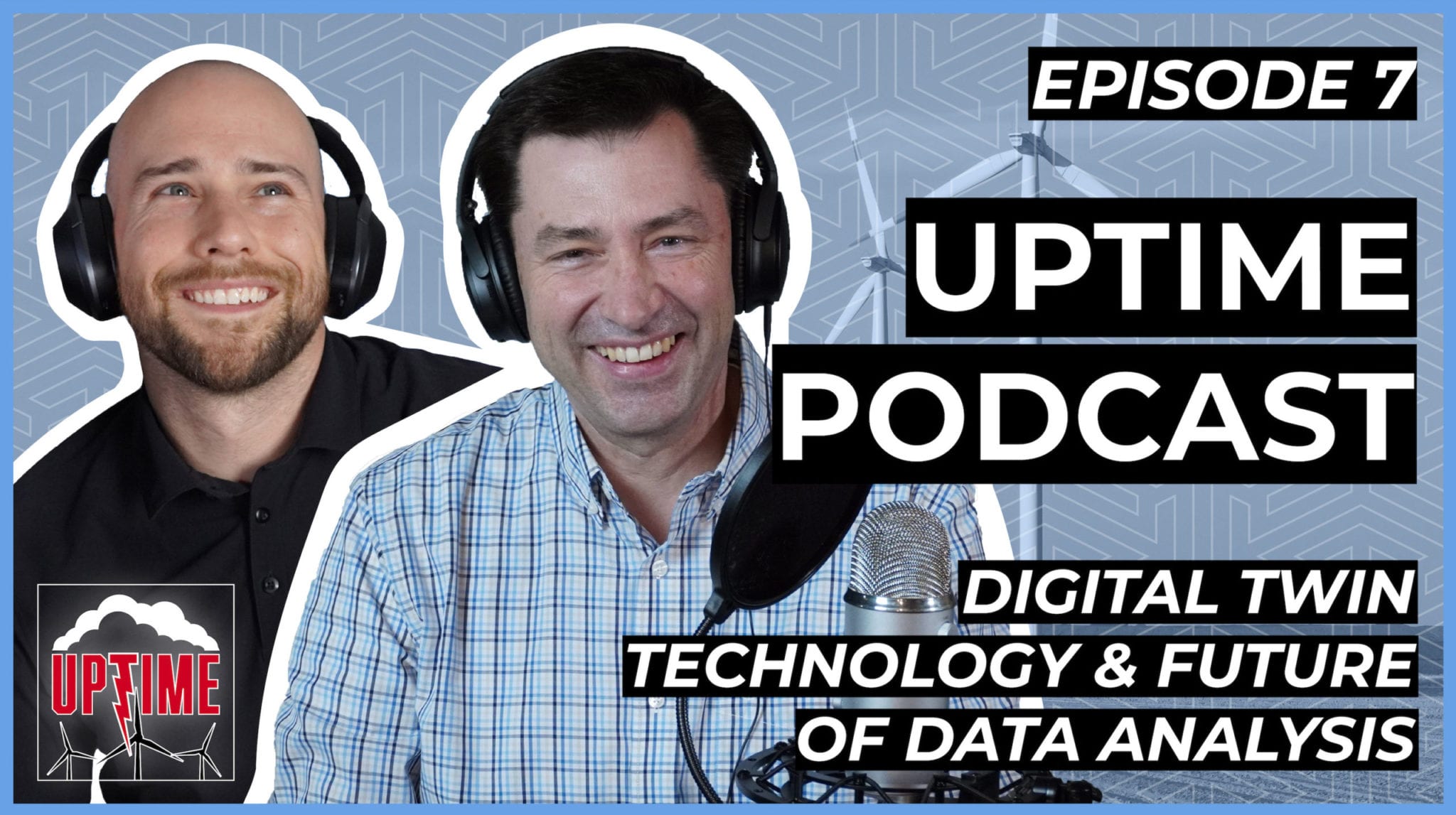
In episode seven of the Uptime podcast, Dan and Allen discuss digital twins, the idea that data analysis can be visualized as an actual twin of the wind turbine in question. Vestas announces huge jobs cut and a wind turbine goes down in Kansas.
Learn more about Weather Guard Lightning Tech’s StrikeTape Wind Turbine LPS retrofit. Follow the show on YouTube, Twitter, Linkedin and visit Weather Guard on the web. Have a question we can answer on the Uptime Wind Energy Podcast? Email us!
Podcast: Play in new window | Download
Check out the Windpower Engineering article on digital twins here: https://www.windpowerengineering.com/how-digital-twins-could-transform-the-wind-energy-industry/
Transcript
Dan: All right. Welcome back. This is the Uptime Podcast. This is episode seven. I’m your cohost. Dan Blewett, and I’m joined here remotely by lightning protection expert, Allen Hall. Allen, how you doing?
Allen: Hey Dan. Good. How are you?
Dan: I’m doing great. Doing great. A little more energy this week. A lot of rain, but it didn’t deter me.
I got some good smells going on in my, in my place at the moment and got some pine tree scented wax melt or something. So it
Allen: smells like the outside.
Dan: You haven’t seen smells like the forest. Yes. So doing all right. Doing all right. How are you doing?
Allen: well, you know, we’re just kind of in quarantine mode.
The governor extended our quarantine till May 18th. So we thought we were going to get offs, out of this quarantine sometime next week at that. That was the original plan, I think of May 4th or fifth was the original date. So now we’re out to May 18th, and everybody’s going stir crazy. Massachusetts has had a little bit of uptick in, in Corona virus cases, new cases.
So the, the issue is. Massachusetts is a very long state and very narrow States, and Boston is near the water and we live on the far opposite end. In fact, grow on the state line. So when things happen in Boston, what tends to happen to the whole state ends up. doing the same thing. So Boston being in the Capitol, Massachusetts decides that there’s, there’s, an issue in Boston for coronavirus, so the whole state shuts down.
So we, on the Western part of the state are just kind of wondering what’s going on and when we can kind of get back to work. In fact, today, I thought. I was just going to and from the office and thought, boy, there’s a lot of cars on the road today, so I kind of wonder if people are starting to hit the streets again.
You see a lot of masks. All everybody’s got a mask on and the grocery stores are full of masks. You see people walking up and down the streets, which you didn’t see a week ago. So people are starting to get out and about a little bit. I think in our case, it’s pretty calm in this part of the state.
Dan: Yeah.
Well, so what’s your opinion? So we’re, I was talking about this on one of my other podcasts. the idea of, you know, businesses opening back up and people are starting to get, like you said, more than just a rumbling. But I mean, some people are protesting, obviously about, you know, we need to get to bed, we need to get back to work, let us take on the risk, whatever.
obviously, I don’t know why barbers have been like the highlighted ones. I don’t know why. Like if they seen a salon owner, like I get that. Like, I have no issue with salons and barber shops opening up like small foot traffic. You know? I feel like that’s reasonable. If you’re going to slowly, you know, let some businesses reopen, that seems completely fine.
Like we can’t be in this forever. Right,
Allen: right. We can’t be in forever. Don’t you worry more about being on a bus. Or being in a taxi, I would too. those, those places don’t make any sense to me. I’m not going to a movie theater. I’m not going to a concert. But one-on-one with interaction obviously is someone who’s cutting your hair is going to be dealing with a lot of people from a lot of, from the surrounding area, typically not coming from too far away usually.
so I think it’s just sort of a where the risk is and whether it’s worth the risk. I think one on one where everybody’s doing really well. I’ve seen a lot of hand washing. I’ve seen a lot of masks. I see a lot of people not touching their face.
Dan: Yeah.
Allen: So if you change their behavior and people’s behaviors have changed and you know, it becomes a lot less of a risk.
I think everybody’s on higher alert still, but you don’t, you don’t seem to be to walk up to you and say hello. They, they’re six feet, eight six to eight, 10 feet away. The stopping to say hello.
Dan: Okay. Yeah, I think that’s fine. Why don’t you start to think about it like what are the odds? The one person that I go spend, you know, a minute with.
Like, if you’re, if you’re just like, stop a random stranger on the street right now and just like sit down and have coffee with them, like what are the odds that that one person has grown a virus? You know what I mean? Like, it’s very low and especially in certain places, it’s a lot lower. What’s, what’s weird in DC right now, they send out, like if you follow mayor Bowzer, who I think is doing a really good job, if you follow her Twitter account, she tweets out every day.
The new cases, like the overall breakdown of ages of deaths. Of, cases by ethnicity, by age of all these different stats. And unfortunately, and this is sad, more than half, I think of the cases in DC or to African Americans. And I think it’s a lot because there’s just a larger population, some of the, the more impoverished areas.
And so the, they also show a breakdown of the, The D, the ATC wards, so that, you know, D C is broken up into eight wards. Yeah. And the four most low socio socioeconomic status awards have over 50% of the cases themselves. So it’s clearly, it’s concentrated in the, in the poor areas, which is sad. And that’s reflected in just in every bit of the stats.
And then, so in my ward. Which I’m more in the center of DC, like I’m, you know, a mile or two from the white house, and there’s a lot more industry there. There’s a lot more business, there’s a lot more monuments for a lot more green space, and it’s a little more expensive to live there. It’s crowded. Yeah.
There’s only 350 cases in my ward and there’s four, 4,000 in DC right now, I think. Something like that. So it’s a, it’s really interesting, the disparity, like the three most. Expensive to live wards have a very low incidence compared to the overall, you know, like one ward has as many as three wards combined.
so it, it’s really weird here in DC. but you started to think about like, again, if like a high end salon opens up in the middle of the city, is that a big risk? Certainly not. and just like some of these smaller shops, but you know, if you walk in and out of a grocery store. There’s a lot of risk, but obviously we need groceries.
So it really is a complex time, you know? And
Allen: are they going to open public transportation? There’s a subway system in D C are they
Dan: going to spend all that’s been open the whole time. And I’ve gone out and I’ve been on it a bunch of times on the subway. Don’t feel unsafe at all because I have a whole car to myself.
So I haven’t, I’ve only taken the Metro once in the last three weeks, I think. And even then it was same thing. Like you walk in, you swipe your card. I literally don’t touch a single thing. I sit down, she put my hands in my lap. There’s no one in my car probably. And then I get out the door wins for me.
I walk with the escalator, swipe my card, and I leave. It’s like, it’s almost like a touchless interaction. And so, well, yeah, it’s been running. Cause I mean that’s, that’s a lifeline. The city people need the subway to go places, but they do the same thing there. You don’t see. The only people you really see taking the subway besides me occasionally is just lower on lower income people, unfortunately.
Allen: And so how’s the, how’s the Uber? Is Uber still running?
Dan: Do they have an Uber? And that’s the thing. It’s like,
Allen: I’m not taking the subway but out Uber.
Dan: Yeah, because I’m not touching anything and I’m, and I can control how far away I am from other people in the, in the Metro, whereas Uber, I’m in their car like, I know I’m going to be six feet from them in the backseat, but.
I’m that distance from them no matter what. Whereas on the Metro, I can position myself in the huge empty subway station and in a huge subway car to be as far away from another human as I want. I feel like that’s a relatively good choice.
Allen: Well, I would have thought of it in completely the opposite. I thought the subways would have been, first I thought the subways were shut down, but if they’re not shut down, they were still have a pretty decent amount of traffic on them.
Where versus versus Uber, which is sort of a one on one. So I’d have been like a hundred to one versus one to one. Your bets are probably better off one to one even if you’re a little bit closer. Yeah.
Dan: Which again, that’s, I mean, lobbying, being logically consistent and exactly what I said before, like what are the odds that your Uber driver has it?
But this time, you know, you start taking like. Socioeconomic status into it. Maybe you think more Uber drivers are likely to have it cause they’re driving around and you know, rather than, I don’t know. It’s a, it’s a, it’s a fascinating discussion.
Allen: Do they have any, do they have any idea about the taxi drivers?
Uber drivers? It doesn’t matter. Guys driving vans to the airport is there, are there cases, Oh huh. But I’d be like, well one of the things were exactly right cause you’re maybe touching different parts of the community, whether those people are running around different parts of community are starting to pick up the virus or not.
Wow.
Dan: Yeah. I think people, it seems like, and this is just kind of conjecture on my part, but I think people in DC who have the means are just staying home. They’re not really going many places. Whereas I would guess that Uber rides in the city are probably people that still need to go to work. And so they’re taking Uber to go to work, which means they’re working around other people, right?
So maybe people who are taking Uber are more likely to be in contact with other people, more likely to then to pick it up, more likely than to give it to an Uber driver who knows? You know, it’s just, again, it’s all conjecture, but yeah. It’s sad that that, I guess more of the have nots are getting it. You never want to see that that’s around.
No, but just more densely populated. And, you know, there’s a large homeless population in DC. And when I leave my apartment and go for a walk, I’m going to go for a run. When we’re done, done filming tonight, you know, I’m going to run past a bunch of groups of people that are just outside, either just, you know, shooting the breeze with each other or they’re, You know, just congregating, just doing whatever, or they’re living outside and there’s a lot of sense in DC. And so you just know that when you live outside, you’re just going to, you’re going to be more at risk cause you’re going to be around other people. So it’s, it’s tough. There’s a lot of interesting factors that are some really sad and, it’s just complicated.
The whole thing’s complicated.
Allen: It. Yeah, it’s really complicated. I just hope that we’re on the downside of this, or as we were told. A month ago, we needed a flat in the curb. Hopefully you guys are flattening the curve up here where we’re on. Definitely on the downside or flat and we’ve been flattened for a week or more.
Dan: Yeah. I don’t know. I think, I think cases are slowly increasing in DC. I’m not super plugged into it. I’m just doing my thing. But yeah, it’s a, again, I don’t, people seem to be abiding it pretty well, but I think the homeless population. And, and just like the, the poor population, cause there is a big divide depending on where you live.
And then, you know, DC is a very expensive, Oh, it’s, I think there’s just a bigger gap there than anywhere else. So when you start to think of the, the, where I live exactly in the city, where there, what are the rates? Like there’s minor, still very, very low, fortunately. So good. So anyway. But yeah, it’s a, it’s an interesting, a lot of stuff going on.
So, in the wind turbine industry, we were just talking, there was, one major, wind turbine damage that made a little bit of news. So what was the story? out in Cairo?
Allen: Yeah, down in Southeast Kansas. They had a, either a high wind situation, which I’m not sure that would be the right answer or a lightening issue where a blade just.
Really got destroyed and hit them the cell and did a bunch of damage. So they’re investigating down there to see what the issue is. Obviously they’re going to go back and take a look at the weather data to see if there was a lightning strike nearby. And obviously it’s going to take them a while to figure out exactly what happened, plus the, the turbines out of operation.
And they got a bunch of cleanup to do and repairs to do. So I guess they got their hands full, especially now with all the crone of our stuff now Southeast Kansas. It’s not the most populous place in the
Dan: world. It’s the Mecca of the world. That’s where the technology is loving starts and stops.
Allen: Yeah.
There’s a lot of good people down there. Independence, Kansas. It’s just independence. Kansas is just sort of North of Tulsa, Oklahoma. So you’re kinda in that Oklahoma, Kansas area, and it’s, it’s a neat area, but it’s not highly populated. So getting people out to this place to get this winter fix is going to be probably a.
Big effort. Oh boy.
Dan: Yeah. And like you said in this, there’s probably, there’s no timetable for that, right.
Allen: No, no. Right there. I think the first thing is to figure out what happened and then get everything just assembled. Get another blade out there. If they’re going to repair it, get another blade out there and get it install and get them to self fixed up.
It’s just like, any sort of significant aircraft incident where you have a breakage on an aircraft or you’re sorta trying to decode what has just happened so you, you catch everything and put it all back the way it should be. It’s a big effort. It’s going to take a lot of man hours. So having, if it’s a lightening strike, it’s going to be very expensive.
A lightning strike for sure.
Dan: So what is the cost of actually, if a wind turbine loses a blade. Like a million, million bucks a blade typically? Well,
Allen: no, no, no, no. A hundred thousand dollars depending on, well, it depends on the size. Largely are the bigger and more expensive they are. But to replace one usually means bringing out a crane.
Cranes are pretty expensive depending if you can get ahold of one now, there should be a lot of them available. You think. But that’s going to be a hundred ish, maybe more grand to get the crane out there, depending on how big the winter burn is too, because of the bigger they come, there are fewer cranes.
There are, it’s going to be a couple hundred grand, and especially when the blade comes off and hits in the cell and does some destruction up there too, then you’re adding onto them the costs because you got to put a new new cell cover on, you’ve got to fix all the equipment that got damaged when the parts of the blade came through.
Hopefully they didn’t hurt the generator. And you know, the worst case ones is when the blade goes bad and hits the tower and takes out the tower and the whole thing comes collapsing down. That’s a, that’s a loss right there. So they, they still have a lot of work to do. I, you know, that’s not a fun time.
That’s going to be a lot of, a lot of extra work they weren’t planning on doing right now. Could you pick a worst time for it to happen? No, you couldn’t have, so, you know, it’s just one of you. It’s one of those acts of nature, I guess, where you just have to deal with it.
Dan: Yeah. Well, it could be producing jobs.
So, Hey, if you want to go clean up this wind turbine, you know, pick up all the pieces, throw them in a satchel. yeah, that’s probably true for you in Kansas
Allen: parts. And one thing about Kansas is it’s windy. So what. Whatever, get the dirt is probably blowing around at all
Dan: over.
Allen: And that’s kind of, that’s a little bit North of tornado alley, a tornado alley.
Ken’s be Wichita area and on the diagonal there up to kind of Omaha, Nebraska. But yeah, there’s still a lot of wind down there. Kansas has always windy. I lived there for five years. Remember toolsets blowing down the driveway because of the wind. Yeah. You’re like, Whoa. Is it really that windy? Oh yeah.
It always blows 30 miles an hour. Welcome to Kansas. The first thing you noticed first, she knows when you move out of Kansas, it’s not windy anymore.
Dan: Yeah. Linda’s thinking it’s the worst. It’s just like, it’s the worst. If it’s breezy Breezy’s the best Wendy’s the worst
Allen: wind is. Yeah. But it makes great power.
I tell you that much. It makes great power.
Dan: Yeah. That’s fair. That’s fair. so when, when these, wind turbines are damaged. How do these insurance claims go? I mean, I know you said in the past that wind farm owners are very cautious with insuring everything they can. And so I think you mentioned that you stepped on a to a wind farm and they made sure that you had insurance, to do that.
So, how, how well do they handle this stuff from an insurance standpoint?
Allen: Well, everything’s about mitigating risk. So the times I’ve been to different wind turbine sites, usually they want an insurance policy of a million dollars before you can even walk onto the facility to look at anything, which I always think is odd because the reason I’m there is I’m trying to save them millions of dollars, yet I got to have a million dollars insurance policy.
I’m not sure what I’m going to do while I’m there. That would have cost a million dollars for the damage trip and maybe fall off of one maybe.
Dan: Yeah, the wind turbines are pretty rugged over. Then it falls over and it’s just like you look around and. 11 of toppled over like dominoes and you just like dominoes and you slink into the bushes like Homer Simpson.
Allen: That would be the only scenario.
Dan: You know what I’m talking about? Yeah. That’s amazing.
Allen: But that’s the thing that kind of runs through your head. Like, I don’t know how I could do that much damage unless I set these things on fire. And even then, even then, I’m not sure. But yeah, so, so everybody is, is risk conscious and with warranties and insurance policies, you got to have insurance on something like that.
It’s just like having insurance on your automobile or on your home. You’re going to have insurance on it, so you want to try to. Mitigate the amount of, of, of claims you’re going to make, right? And the insurance company doesn’t want you to make claims, so they want you to do the right thing, make sure you’re maintaining everything.
So it’s kind of a vicious circle that just like with your automobile, right? They got those little, sensors you put in your cars now so they can track. You gotta make sure you’re not driving too fast or driving to a radically, and they give you discounts on your insurance. It’s sort of a similar thing, right?
So if he could take good care of you, wind turbines don’t have a lot of claims. In theory, your rates will go down. It’s a, it’s a marketplace. Like anything else.
Dan: Well, speaking of, of warranties. So what’s the typical warranty period that, you know, wind farmer gets when he installs a brand new wind turban on his own?
His property.
Allen: Yeah. So, so the, the, the company that wants to install a new the developer, and so when the developer wants to install a new wind turbine site, typically the OEMs offer a warranty somewhere between two and five years, five years. I hear a lot more five years than I’ve heard in the past. But, five-year tends to be a very typical warranty period.
So they got five years to sort of, I call it, in the aircraft industry and other industries. Computer industry is where I first heard it was, infant infant mortality. So as, as the, as a new device starts, it’s more likely to die in those first. Couple of months slash years, and at the very end of the life that’s in the middle.
Once you get past those first couple of months and years, you’re going to be in kind of stable territory. So that’s the highest risk points in that first really in the first couple of months when tends tend to break,
Dan: is that they’re catching like big defects.
Allen: Yeah. You’re catching things. Yeah. You can catch things from that sort of manufacturing defects that you couldn’t see.
like if you had some defect in the blade, you couldn’t inspect an engine, get it up and start operating, and you put the loads in the blades and obviously those defects get amplified. same thing, electrical equipment, the, any kind of semiconductor device you’d like to have burn in time before you start using it because it’s in that initial burning time where most of the devices will fail once you get past that burn in time.
you usually have very successful life. It just got a new car. When you buy a new car in that first six months, if the motor rolls over dead, that’s, that’s not great. You’re like, so, that’s why they offer those sort of warranties that are front or front loaded. The first two years you got a warranty.
Your first three years are going to cover. ground to the top. So it’s the same sort of thing and wind turbines. So as you get it, you want to make sure that you’re in, you’re covered for those first couple of years in case of some sort of manner, manufacturing defect, not necessarily at the OEM, but maybe from one of their suppliers that you couldn’t visually see.
And it just rears its ugly head in those first couple of months. So insurance is a big deal there.
Dan: And so I’ve heard, you know, like some companies like sky specs that their inspections are helping some of these wind farm owners kind of tap into those warranties right before they run out. Like you want to get stuff prepared right before it runs out as a true.
Allen: Yeah. So what you want to do before the warranty warranty, warranty runs out. You want to get all the claims in. So if you do have some sort of OEM related defect, you want to catch it before the warranty
Dan: runs out for sure.
Allen: Right? It’s just like with a car before the car warranty runs out, you want to take it to the shop, make everything’s sure everything’s okay before you continue on using the vehicle.
The same thing happens on wind turbines. The problem with winter misses are so massive. To do any thorough inspection to see you have a hundred turbines to do an inspection on a hundred turbines would take normally a lot of times. So what happens is that the operators or owners, developers, depending who’s owning at the time, who’s going to buy it, they want to do an inspection.
So they would take samples of, so there’s a hundred. Turbines out there. They’ll sample five and then extrapolate out, and then it come to some agreement with the insurance company about how much you’re going to pay out with something like sky specs because they can scan each of the blades and the turbines within roughly 15 minutes per per turbine.
they can do a whole. Field of a whole farm of turbines in a day and have really detailed data. So it just changes the whole marketplace because now instead of sampling five out of the a hundred that they can’t do a hundred terms in a day, but say they do 30 or 40 in a day, so within three days they’re going to scan every single turbine that’s on that site and have detailed data where turbine one is fine, but turbine five 22 and 14.
38 all have his issues that you wouldn’t have caught otherwise cause you’re doing random selections. So it does change the marketplace because now the next owner of that German site or the current owner one gets insurance to collect into, to fix those turbines, wherever they’re going to sell it, they’re going to sell a product that has been, you know, it’s been brought up to snuff before the transaction happens.
So it helps everybody. Right. I mean, it does put a little bit more on us, on the OEMs to make sure those, those wind turbines, you know, at least get through that warranty period without many difficulties. So there’s, you know, it’s a catch 22. They’re a little bit on the OEM side, but for someone like sky specs.
It makes a lot of sense where they can come in and quickly do a number of inspections, accurate inspections, and it just gives everybody data, right? All our whole world right now is depending upon data to make smart decisions, and I don’t know how anybody would do without actually looking at each turbine.
That’s the only thing that makes sense to me.
Dan: Yeah, no, that’s a, yeah, it’s, that makes a lot of sense. And obviously the faster you can get them all assessed and Oh yeah, that process done, that’s going to be way easier. Cause I’m sure you know, five years ago when there were no drone inspections or 10 years ago, whenever it was, it was a huge process.
Like yeah, let’s get a hundred men out on ropes and climate. Like.
Allen: Yeah. Not possible.
Dan: Right. Terrible process. Yeah.
Allen: Yeah. A couple of guys going down a ropes and they’re doing a visual inspection. They can’t do nearly as much as a drone can do, especially from sky specs. Those things run so fast and take so much data.
There’s no way a human could do that. No way.
Dan: Yeah. So there’s a really interesting article I want, I want to cover today. It’s called how digital twins could transform the wind energy industry. It’s by Sue banker pal, who’s a guest contributor to the, to their site. and basically the article is about how, with obviously these physical assets, like a wind turbine.
you’re essentially can think of the data that you harvest from it with enough really good, like high quality sensors making a digital twin or digital mirror of the assets. I’ll, I’ll read a line from that, you know, that says, so. So this information can be sent via the cloud to piece of software for interpretation and scrutiny, either in the form of a three D digital representation or raw data.
So basically the taking all this data and saying, here’s what this data looks like as a three dimensional representation of. The wind turbine. I know I said turbine turbine, don’t need to throw in the, in the British accent. how do you feel about this? that sort of like breaks my brain a little bit.
How do you feel about this?
Allen: Well, it’s similar to what we have already done on aircraft in a sense where, especially on helicopters, anything that rotates, vibrates, and so a rotating wind turbine blade, there’s always vibration. And. Shaking and stresses and loads. The helicopter is very similar. it sounds like what we like Sikorsky did years ago.
They got these health and monitoring systems on there where they’re sensing for unusual vibrations and they know what a good vibration is. Cause the helicopter is always shaking. So you, you look for good vibrations. When you see something start to wander from what’s normal is you can flag it and catch it early before something.
Bad happens with catastrophic happens, but in that system it’s just shoving out data. It doesn’t really tell you exactly what’s going on on the helicopter, and it sounds like in this wind turbine application where they’ve got this virtual twin, they’re trying to take the data, or they have a bunch of sensors on the wind turbines, they’re trying to take that data and provide a visual image of what’s actually happened.
That’s probably the. Most difficult part for anybody who is working in O and M is to visualize what this sensor data actually means in terms of reality. You know, Dan, maybe it’s, you see a bunch of just raw data on a chart. What does it mean?
Dan: Yeah. I just go in line. I go blind. Essentially.
Allen: Yeah. Like, I don’t know.
What does this mean? What does it mean? I’ve got to change the bearings in this wind turbine? Or does it mean I just need to change the fuse over here? I don’t know. Right, right. Probably then that’s probably where they’re going. If you could create a virtual wind turbine and say, Hey, point to the area where you think their issues are.
Maybe the areas where there may be problems. Obviously using previous data to help pinpoint where new problems can occur. That’s not a bad move, right?
Dan: Yeah. When it kind of reminds me of a, you know, like all those futuristic movies where all like the war rooms, right. It’s got like, they have this big table and they manipulate all the little screens like they’re moving around the symphony.
I was actually watching a minority report.
Allen: Oh yeah.
Dan: Okay. Was terrible as a movie. It was terrible. I actually slash read the book by Phillip K Dick, and I really enjoyed it. It was like. A very intelligent, you know, like, and they changed so much of it. Now was the movie visually like fun? Absolutely. but anyway,
Allen: that’s a Tom cruise movie.
I mean, how many bedtime
Dan: movie expanded Tom cruise. He’s insane doing all this crazy. Anyway. Mission impossible. Good actor. Alright. Okay. I have a toe. I’m not a huge action movie person, so I have a tough time separating the fact that he’s like an insane person in real life versus a, you know, his characters.
He’s an actor. He’s a good actor. Yeah. He acts the same person, his movies. He’s insane. And really, anyway. so, but in that movie, he’s like, you know, the first one of the first scenes is him like manipulating the data from the precogs who, if you’ve never seen minority report or read the book, I highly recommend the book.
It’s only like a five hour audio book, not super long, but basically the premise here, getting off, getting off task is that, Tom Cruise’s character runs the pre crime unit. Which, there’s these three basically mutated humans who can see into the future and they spit out this data into, they basically say like, this murder is going to happen.
So then the pre crime unit goes out there and arrest the person before they commit the murder. and of course in the book, it’s like all crimes. It’s not just murder in the, in the movie, it’s only murder. But, so Tom cruise is like visualizing. He’s, he’s got this visual big glass screen that shows the readout of the data of like basically what the precogs, you know, these, these being seeing as a future are seeings.
He’s like trying to like make it, make it make sense. And so I feel like that’s kind of what this is like. Obviously like so many of those futuristic movies have these things where it’s like this table where they’re visualizing the data. It’s like these big table computers or holographic computers. But this kind of reminds me of the same thing where.
you could have like you walk into this big room, it’s like your dedicated virtual digital twin room, and there’s your whole wind farm, like in augmented reality. Operating. You can see all, every, you know, how fast every blade spinning, like where they’re oriented, all that stuff. And it’ll tell you, you know, the bearings are, you know, getting a little hot on this one, or like this ones, you know, all those sensors are giving you all this data and you can say, Oh, turbine number 17 it looks like he needs some attention.
Next week he’s been, you know, running a little, little sluggish or whatever it is. And it’s kind of like iron man’s, right?
Allen: You ever see an iron man? You’re, you’re not a Robert Downey jr fan either. Oh my God.
Dan: I do like Robert Downey jr, but I am not in the movie slash TV world. The last bunch of years,
Allen: infinity war, the most popular movie ever.
Dan: I watched him, I watched him on the Joe Rogan podcast, which I, which I liked. He seemed to be very thoughtful. I’m good dude, but
Allen: he may be a great dude, but iron man, infinity Wars Avengers,
Dan: none of it. I’m not as, I’m not as nerdy as you. All right. I’m not a
Allen: nerd, and most of the world has seen it. You’re in the slight sliver society that has not seen it.
If there’s anybody that’s the nerd,
Dan: you’re getting upset, which is giving me more. You’re validating my, my nerd, my nerd, your nerd instinct. Currently my nerd labeling of,
Allen: I’m not sensitive. You’re sensitive, right? Isn’t that how it works, right?
Dan: Yeah, exactly. No, I was, I was a Spiderman kid growing up and I, I liked the Spiderman movies, but they’re like.
They do keep changing
Allen: every time. I’ve seen the same movie three times. Come on.
Dan: I agree. I agree. Anyway, I digress, but this idea seems pretty interesting where, cause again, it was just like this stream of data into spreadsheets and like what human being has the. The, I mean, obviously some of these data scientists do, but this seems like it would make sense going forward
Allen: to have translating data to reality is such, it’s the hardest part of anything, right?
It’s just like your iPhone. You’re just a bunch of noise in the backside, but it’s translated to something you can actually use. It sounds, it’s, it’s similar to that, right? Anything that gets to a good user interface is going to be successful.
Dan: Well, it also opens up up these jobs potentially to people that.
Aren’t just the ones who are gifted enough to be able to stare it, just do it. Right. But in all seriousness, I mean, there’s a lot of people who are very visual learners or very audits or whatever. Yeah. And this gives you, Oh, I could do this job. Whereas in reality. You know, 10 years ago, it’s like, I don’t want to just be looking at data streams all day in spreadsheets, or, you know, all that.
So that, that’s intriguing. It could potentially open this up to a lot of other people. last thing I want to cover today is a Vesta. So it says wind Vestus when giant Vestus is cutting, it looks like about 400 jobs. so obviously some more downturns for the industry just because of Corona virus and all the potential implications.
And I think some companies are trying to get out ahead of it. So, what are your thoughts?
Allen: I understand why they’re doing it. I understand the financial implications are, they’re trying to make sure the company is secure financially as they go forward. And once the coronavirus thing tampers down, hopefully by the end of this year, you know, we can all kick back at it again.
But in the meantime. Man, it just delays all the, all of the great things that they have been working on. And it pushes everything to the right. So in the winter, interpret industry, new techniques, designs, improvements, are just part of that industry. When you take 400 people off the playing field. It just slows down the whole industry.
So it not only hurts economically because all those people are have to find something else to do or just kind of find other work. You hate to lose them. You want them to come back, right? You will. We want everybody to come back to where they were to get everything up and running again. But man, it’s a, it’s a big blow because it’s hard to find.
Good people in wind. It’s such a special, specific field, and you take a specific skillset all the time to do the things that they’re doing. Once you lose those people, it’s not like you can always get them back. So it just sets back companies. We sit in that aircraft every, every seven years. It goes through cycles and a lot of good people go off and say, I’m not doing that again.
I’m not going to be an industry that’s cyclical like that. And they’ll go find something that’s more stable, go work for a government somewhere. And it just drives, it dries, it dries slow periods in the economy and improvements in the world. It just does it. You see it down there. Washington D C right.
How are things in Washington D C are pretty stable government wise, the most stable job has probably be working for the government.
Dan: Yeah. There’s a lot of, I, I do assume there’s probably a lot of stability here in the city because a lot of lawyers who I assumed were probably still. Doing the same work.
there’s a lot of government jobs, obviously, like the IRS is here, like all these big agencies, you’re here, there’s a lot of nonprofits. Those ones are probably a little more, questionable in this, in this climate. but yeah, those are, those are the three big ones for sure.
Allen: Yeah. Yeah. You just hate to see it.
Dan: There’s a lot of tech over here as well. And just in the DMV area that the DC Metro Virginia, so
Allen: yeah. But hopefully, hopefully though that at least in a wind turbine industry, we can get back going again and again. You know, obviously if you’re working in an industrial site, which mostly is wind term, places are quasi industrial, depending on what part of the business you work in, it could be close to work when somebody else that you’re trying to assemble these in the cells and generators and things of that sort.
So you don’t want to be working that close together. And some part, I make sense that you’re going to provide some separation, but you know, layoffs are a different story. Everybody’s going home. That’s not good.
Dan: Yeah, I mean, I think one of the big questions is like, if there’s any of these startup companies, like obviously there’s a lot of startup, drone inspection companies in the sector.
There’s obviously, it takes a lot more capital to get into the, you know, the manufacturing blades or manufacturing wind turbines themselves. But all of these small companies are probably maybe not going to survive or they’re gonna have to really pivot heavily and quickly. To survive the downturn. So it’s gonna be interesting to see how that plays out.
Allen: Yeah. Yeah. It’s gonna be interesting times, right? We’re in interesting times
Dan: while on the one, I mean, I think the one thing that’s, and this is, I was speaking probably a little bit from ignorance, but I mean, it seems like the inspection repair stuff, at least for the technicians themselves, a highly specialized job.
Yeah, I mean, so I think they’re still probably hopefully going to be still heavy, very heavy demand as they start to ease restrictions. Cause I assume as soon as a lot of these restrictions are eased. They’re going to be sending repairmen back out real quick to get these turbines looked at that haven’t had any attention the last couple of months.
Allen: Yeah, it’s a, it’s a big part of the industry, the spring time, at least in the Northern hemisphere, as things warm up over the winter time, it’s very hard to go out and do repairs or do inspections for that matter. So now’s the time. Everybody usually is
Dan: getting to go. Lovely time to be 800 feet off the ground, dangling from a rope.
Hey, it’s a book freezing.
Allen: So it beats, beats being out there. What a zero outside. so you’ll see a lot of of activity typically this time of year. So it’s like April, may, June, right is the big go out there and fix stuff that happened, over the winter time. So if everybody is sitting at home waiting to get back to work when they’re going to have more work, by the time they get out there, so they’re going to be really busy once the, some of the restrictions have been lifted.
Dan: Yeah. And if anyone’s out there listening and you want to take me on like a ride along to go up the turbine and I’ll repair it, I’ll work for free. I’d be terrified. So I might need a second, like a adult diaper or something. But, if you want to bring me along. Just, send us, send us an email, Dan. Dot.
Blue. It just hit me up.
Allen: Put a GoPro on your helmet and go,
Dan: Oh, for sure. It would be, it would be a fascinating experience. And I, I do think, I mean, once you learn all the safety stuff, and I mean, these guys were the ropes. the rigging is pretty incredible and they know what they’re doing to stay safe.
There’s a lot of redundancy and. Very high skill. I mean, like again, that’s a very technical job. A lot of training, but that’d be pretty cool to be on top of one of those things. Yeah, the views are amazing. So, so open invitation if you want to have me come along.
Allen: D.M. Dan right?
Dan: just let me just let me know.
Yeah. So, alright, now we’re going to wrap up, but, another good episode if you’re out there listening. Thank you for being here on the Uptime podcast. Just as a reminder, leave us a review for the show. you can find us on Spotify, iTunes, YouTube. So for full episodes on video and for short clips as well, we kind of chop the show up into topical clips just so when you’re, just on the movie, you don’t have time for a whole 30, 40 minute episode.
You can grab a quick byte. And be sure to visit us on the web at www.Weatherguardwind.com, and obviously it all of our social media outlets, Twitter, LinkedIn, Instagram. We are @wglightning. Allen, you want to sign us off today?
Allen: Well, thanks everybody for listening. This has been the Uptime podcast.
Check us out on the web.
Dan: Alright. See you next time.