



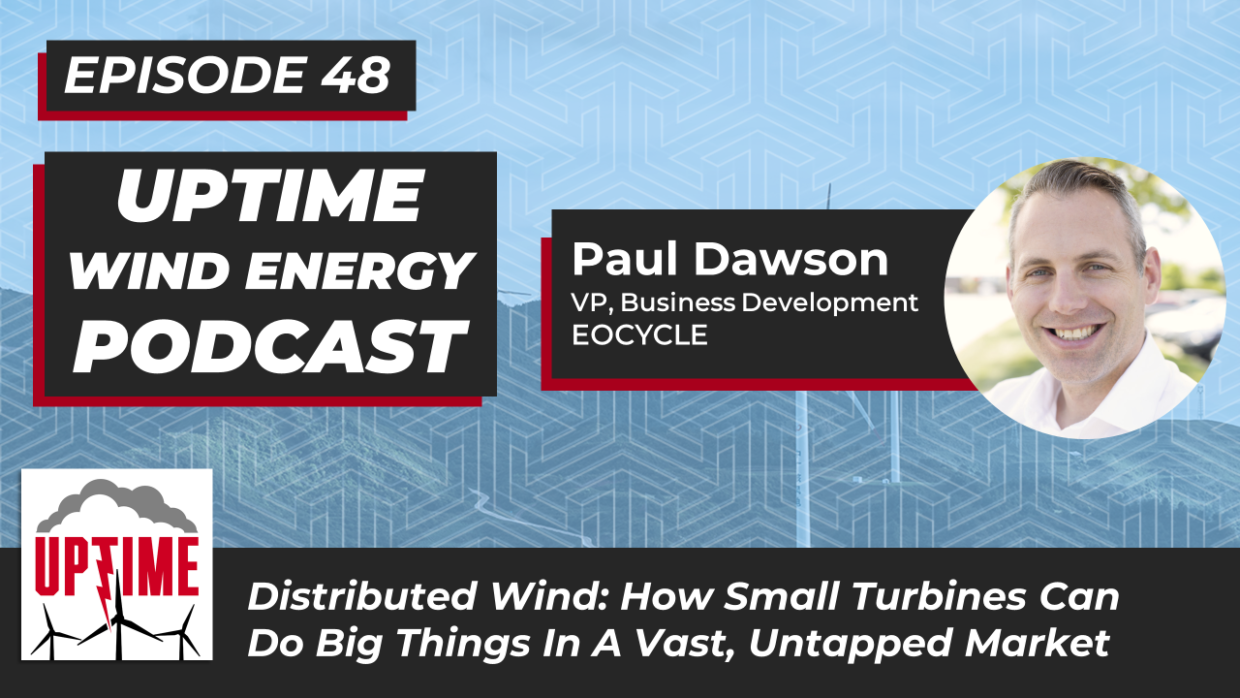
Paul Dawson, VP of Business Development from EOCYCLE, joined us to talk about the distributed wind sector of the market. Small wind turbines have a large market, with studies identifying 49 million potential sites that could benefit from and support a turbine. EOCYCLE has two models that are fit the power needs of small businesses, with a specific focus on farmers who can benefit from generating their own electricity and reducing or eliminating dependence on the grid.
Learn more about distributed wind and EOCYCLE’s technology on their website, Linkedin page, Facebook page or YouTube channel.
This episode is sponsored by Weather Guard Lightning tech. Learn more about Weather Guard’s StrikeTape Wind Turbine LPS retrofit. Follow the show on Facebook, YouTube, Twitter, Linkedin and visit Weather Guard on the web. Have a question we can answer on the show? Email us!
Podcast: Play in new window | Download
Transcript – EP48 Paul Dawson from EOCYCLE on the Future of Distributed Wind
Dan Blewett: [00:00:00] This episode is brought to you by weather guard lightning tech at weather guard, we make wind turbine lightning protection easy. If you’re a wind farm operator, stop settling for damaged turbine blades and constant downtime. Get your uptime back with our strike table lightening protection system.
Learn more in today’s show notes or visit weather guardwind.com/strike tape.
Welcome back.
I’m Allen hall. I’m Dan Blewett and this is the Uptime podcast where we talk about wind energy engineering, lightning protection, and ways to keep your wind turbines running.
welcome back to the uptime podcast. I’m your co-host Dan Blewett. No Allen Hall today, he’ll be back with us in a couple of weeks, but we have a great guest today. Paul Dawson vice president of business development from EOcycle. It we’ll be here with, uh, with us for a great conversation. So our talk today is about distributed wind.
EOcycle is a distributed wind company. They sell their flagship, uh, wind turbine is the EO25, a 25 kilowatt model. That can provide power for about 10 to 15 homes, but they’re not really in the residential market. They’re really in the small business market, specifically targeting lots of farms in the Midwest and in other areas where a small wind turbine is going to work.
So distributed wind is an interesting segment of, uh, the wind energy market. We want to talk to someone about us. We could get a feel for. You know, the, the, the smaller space that GE and Siemens Gamesa investors really aren’t paying much attention to. So, you know, if you, if you float around social media, uh, Twitter, YouTube, you’ll see lots of really interesting designs, uh, whether it’s these traffic vertical turbines, which is a new prototype out of Turkey or any of these little things where we’re trying to capture excess energy, you know, wave a wave is a thing, right?
We’re trying to find ways to squeeze more energy out of the world, essentially in so small wind is sort of like mid rain solution for that, right? It’s not this tiny thing that’s going to do one kilowatt a year. It’s, it’s a pretty significant solution for small businesses. Um, and farms is, is one of their main target markets.
So Paul is a, a wind energy lifer. He’s been in the industry for the past 15 years. Uh, currently again with EOcycle as vice president of business development. But he’s also worked for, uh, switching gears. Uh, he was the director of business development and sales for Northern power systems. And he was also the global sales manager of energy systems to name a few, so really great conversation.
And I think you’re really gonna enjoy it on distributed wind. So without further ado, let’s jump to our conversation with Paul Dawson.
So thanks for joining us on the show. I really appreciate it. Great to be here. So let’s jump right into it. Uh, you know, EOcycle, I kind of mentioned this on our last podcast. I think the distributed wind sector is really interesting. So you guys are in distributed wind. Uh, can you just quickly speak to the difference between distributed wind and big wind and, uh, you know, what kind of that.
That market is that you guys are going after.
Paul Dawson: [00:03:27] Sure. So I’m intimately aware of these differences. Having worked in both, uh, both sides of this industry, uh, the big wind industry is all about, and I know your podcast is all about this. It’s the wholesale markets, uh, it’s large-scale developers, uh, large wind turbines.
The distributed wind industry is focused on. Um, customers generating their own electricity for their own use for use onsite. And so as a fundamental difference, we’re not selling into the wholesale markets. Uh, you’ve probably heard the expression before, you know, spinning your meter backwards, uh, to, uh, offset the electricity that you are, that you would otherwise be purchasing from the electric grid and in doing so, uh, you will, uh, reduce your electric bill save, uh, gaining energy independence.
Dan Blewett: [00:04:15] So. This sounds like this is the same market as like solar, as like my parents, you know, the salesman came out to them a number of years ago said, Hey, your house looks perfect for solar. You guys have a lots of sun. We’ve done a study in the area. Um, would you want solar to reduce your costs over time? Is that sort of like the corollary, like, is this similar to, to what solar has done in the past, but obviously you guys aren’t necessarily going after residential, right?
Paul Dawson: [00:04:39] Uh, yes, it’s actually, uh, a great, uh, a great analogy. Uh, in our case though, we tend to work in rural settings versus suburban or urban settings. And that’s the key difference. We really go where the wind is.
Dan Blewett: [00:04:54] Gotcha. So tell me about that. So obviously the Midwest, I lived there for the past most of the past nine years, and there’s a massive, uh, commercial wind farm out in McLean County, Illinois.
Some wonderful people still out there. And at night as you’re driving down, uh, I guess it’s 66 or no, route 70 man. It’s only been a year. Mark, are you forgetting? But you can see these like 200 turbines I’ll have their red, uh, aviation obstruction lights flash at night. It’s the craziest craziest site. So obviously there’s tons of land out there.
Um, and some of it’s bought up by commercial. Um, but you’re saying that some of these smaller farms, they could just. Do their own power off the grid or not necessarily off the grid, but they can be self-sufficient.
Paul Dawson: [00:05:39] Exactly. So, uh, and it is a good point. The, the question of on, or off-grid, uh, is one that comes, comes up a lot.
A lot of people think that when you get a wind turbine, Oh, you’re suddenly completely disconnected, uh, while it is possible. Uh, there’s a lot more technology that needs to go into that in storage. And we are working on that, uh, on a, on an offering to, to bring that to the market. Uh, but the easiest and fastest way is to simply connect it to the grid and.
Reduce a portion of the electricity that you use. So when the wind turbine is spinning and you need electricity, you’ll take that electricity as a priority. Uh, when the wind turbine is spinning and you don’t need all the electricity, it’s pushed back onto the grid and depending on the policy, uh, that will determine what the value of that electricity is.
Maybe, and get a credit, a kilowatt hour credit. Uh, you may get some money. It may be a retail rate. It may be a wholesale rate. Um, but you’ll get some sort of credit. And if the wind turbine is spinning, you’re taking all the electricity and you need even more than that. Well, you’ll just buy the difference from the electric, from the grid and the provider.
Dan Blewett: [00:06:44] So going back to like, uh, solar, as an analogy, solar has gotten a lot cheaper over the years. Um, how has the cost, uh, you know, does it change a lot based on geography? Like if you put a wind farm up in Indiana or. I misspoke. If you put a, you know, a wind turbine on a farm in Indiana, is that going to be similar in cost to wind turbine on a farm in Minnesota or North Dakota?
Paul Dawson: [00:07:07] So while project crossed costs, don’t vary tremendously from one region of the country to another. What does diff uh, is different? Are two things that really influenced, uh, the, uh, the return on investment payback. Um, one of those is the electric rate. So what you pay for your electricity that’s because that effectively is the value of the electricity that you are.
Uh, turbine is generating. That’s what you’re offsetting. And so that will be an important factor. And the second one is the wind speed and unlike, uh, solar, uh, that is much more regional. Rachel have, and certain areas of the country will you’ll have a certain solar resource and it’s more or less the same everywhere in that area.
Uh, wind energy, uh, is, uh, very dependent upon the wind speed, the amount of energy in the wind. It’s a cubic function. So, uh, a doubling of the wind speed and is in theory, uh, eight times your, uh, the output. So in practice, it’s a little bit less than that, but the point remains the same. And that is the finding.
The windy spots is critical to, um, citing your wind turbines and picking, picking your markets. Here in the U S uh, it’s there there’s, there are windy spots all over the country. Um, but down in the middle of the country, uh, in the great Plains Midwest, uh, there is an awful lot of wind. And, uh, I always like to say, you know, you can almost drop a wind turbine out of the sky.
And they will land in a windy spot.
Dan Blewett: [00:08:40] Yeah, that’s true. That’s one of the key differences. Is it snows out my window here in DC? It’s like 30, probably outside and not that windy, whereas in Chicago, uh, near where I used to live, it’s probably zero and snowing sideways. So lots of wind generation out there. Um, so yeah, you’ve worked in big wind for a long time.
Can you speak a little bit about your, about your past and because I want to get back to the differences between the physical. Um, devices. I know, obviously there’s a big difference between a commercial wind turbine and your technology at EOcycle. So, um, tell me how, you know, your, your path a little bit through the industry, and then let’s get back to, um, you know, the differences here.
Paul Dawson: [00:09:20] Sure. Well, the big break I had was with a company called NRG systems, uh, which was the global leader in wind measurement equipment. And. They work with all of the major developers around a large scale when utility scale wind developers around the world, uh, I was our global head of sales and got to interact and, uh, learn all about, uh, the challenges and opportunities of utility scale, wind development and markets on far-flung places and domestically.
And that was a real, a real, um, Learning experience that was, uh, was fantastic. It was a great company, uh, and, uh, really just gave me the perspective and the background. I needed to understand, uh, the big wind space. Um, there was another company in, and this was in Vermont and at the time there’s another company in Vermont, uh, that was working in the distributed wind space and they were leading the market, uh, at that time.
And I’d opened. I saw an opportunity and I said that these guys had an idea to, uh, try to bring this distributed, uh, when to markets all over the place. I thought, Hey, this is, I could, I could transition into this. Uh, and, uh, we could see some of the same growth curve, uh, that things, uh, they struggled financially and, uh, ended up leaving there, but, uh, found a company called a EOcycle that I’m with today.
And, uh, they actually found me and, uh, we, uh, started working together and this is a, this is a company, uh, that is, that had the vision, uh, the exact vision that I had for the small wind industry. I didn’t realize they were, they were doing this. And so when, when we spoke, it was like, okay, we’re doing this.
And the concept essentially is. To bring the, uh, the rigor, uh, and, and the technology and the learnings of the big wind industry and scale that down into the small scale distributed space, so that that can be deployed at volume. Right. There’s huge, huge opportunity in a distributed wind space. Uh, that’s not been tapped yet, right?
Unlike solar that has seen some exponential growth. The small wind, uh, space is just at the very beginning of this curve. Uh, and there’s so much opportunity, right? The distributed wind energy association has identified 49 million sites in this, just in this country where a small wind could be deployed.
And. At the moment, it’s just a tiny, tiny fraction of that, where that’s been, uh, that’s been, uh, projects have gone in. So, uh, there’s a huge opportunity to do that, but the industry has largely, uh, been, uh, for the last it’s been around for a long time. It’s been, um, um, bumping along, I’ll say for 30 plus years.
And there’s been some, some very passionate and very smart engineers and people in this industry have really given it all. Um, but I think now it’s time, uh, for, uh, some new, some new energy, um, and perhaps some, uh, additional perspectives to help drive this, uh, at scale. And that’s really what needs to happen and to, to, uh, bring this.
But really this to fruition. Cause there’s just so much, uh, and there’s, it’s really, there’s a, and there’s a huge need, right? The huge demand I should say. Uh, distributed wind is increasingly popular. Used to be more of a environmentalist green lefty kind of thing. Yeah.
Dan Blewett: [00:13:03] Quirky guy has a, has a, has a windmill on his, on a site.
Yeah
Paul Dawson: [00:13:06] exactly. Now it’s, it’s going mainstream. Uh, it’s gone across the political divide, right? You’ve got people that say has less and less to do with politics. It just makes sense. Um, but what there needs to be are good solutions and turn the easy to use, you know, plug and play kind of stuff that just works.
And that’s what we’re trying to. That’s what we are bringing to the market here today. Well, and
Dan Blewett: [00:13:33] so there’s some key differences in the technology too. That seems so. So to make it a little more friendly for, you know, potentially like small islands and some really remote places. Uh, and obviously we talked about that there was a, a different technology called type the wind turbine, which I’m not sure how their company’s doing.
We’ll probably to check up on that. They had a really interesting, unique design. I think, I think they were also maybe a vertical access, which I know those designs have had some trouble in the past, but. Yours is, is, is durable in the sense that it’s, it’s folded down. It doesn’t have a gearbox it’s maintenance sealed, uh, hydraulic motor.
Um, can you talk a little bit more about, uh, you know, the, the physical attributes of the EO cycle, EO25 and why that might be suited for some of these tough environments that you probably couldn’t plop down. You couldn’t throw down a three megawatt, um, you know, turbine out of, uh, out of a helicopter, like that’s right.
Paul Dawson: [00:14:26] That’s right. Yeah. So, uh, Yeah, it was so we quickly realized, uh, several years back when, when preparing the next generation of our wind turbine, uh that’s we needed to have an extremely robust and low maintenance turbine, right? Unlike wind farms, where you have maintenance crews, uh, nearby or ready to, to come in at any moment, small wind turbines can’t can’t support financially can’t support.
A large amount of maintenance. So we had to come up with something that would still have a great amount of output, but with greatly simplified the wind turbine. So we looked at the components that had the greatest failure rates and we tried to one by one, uh, tackle them. So one of those, uh, Uh, it was blade pitching.
Uh, so we, we have gone with a stall design, a blade. So essentially what we’ve done up broadly is try to remove, remove as much as possible moving components. And so, as you mentioned, generator is sealed pick split spades direct drive. So no gear box sealed a generator. And then, uh, as you mentioned again, we’ve, uh, we now use, uh, a tilt top tower design and 80 on an 80 foot tower.
And. That, uh, that allow really allows you to go into a lot of, uh, more remote places, but also even in very accessible places and reduces your costs and your project costs and does not cause any disturbance on, let’s say a farmer’s land. Um, and if you have maintenance, it’s easy. You can send a couple of guys, they can tilt down the turbine and, uh, this all contributes to.
Reducing the number of visits, or if you do have to visit, keep that cost, uh, very low names, just your annual preventative maintenance.
Dan Blewett: [00:16:12] Yeah. And so that seems like one of the, the main deterrents people would have they say, all right, so I’m gonna have this tower, then I’m going to be now responsible for all my wind farm.
Like what if this thing, you know, acts up. It’s not working. Like I’m not going up there and now we got to call somebody that seems like a really expensive, obviously we know how much, um, training, you know, people need to go up these things. It’s expensive to have a crew out there. So it seems like you guys have been working hard to mitigate those from the beginning.
Paul Dawson: [00:16:41] One of the key, uh, Changes that we made again, a few years back was to move from being just a turbine manufacturer technology provider to a solutions provider. We now offer a turnkey solution. Uh, so customers, uh, don’t need to. Become wind experts. Right. That was a key. And I think that’s essential to, uh, to, for others to do the same in the industry.
Uh, there, there isn’t the industry maturity yet, or the, the network yet, um, where you could have multiple players. Nor can the, uh, the, um, market economics support it. So, uh, it was a great move. Uh, we haven’t regretted it and, uh, it’s been going very well for us. Uh, again, it’s just this idea of, you know, customer comes in we’ll, we’ll evaluate the win for them.
We’ll do all the technical, uh, Pieces of the analysis, the siding, get them to sign off on it. And then it’s, uh, uh, we take care of the development cycle, a permitting process, the construction, and then they sign a maintenance contract with us and, uh, we’ll take care of the full life. Well, life cycle. So they really just need to.
Watch their watch their electric bills and see how much they save.
Dan Blewett: [00:17:57] Gotcha. And then you guys have two turbines, so you have the EO25, which is like your, I’d say your flagship model and then you have the new XANT line. So that’s from a company that you guys acquired, so, right,
Paul Dawson: [00:18:06] right, right. So, thanks for mentioning that.
Uh, we have been talking about the 25 kilowatt and that’s still primarily the wind turbine that we’re. Uh, that we’re selling here in the US as it is certified. So it’s eligible for the tax credit. Um, but we have added the XANT line and it’s a hundred kilowatt wind turbine, uh, Belgium, uh, company from Belgium and, uh, with a lot of the same, uh, philosophy and approach.
Uh, to their wind turbines and we now see an opera and we saw an opportunity to bring a larger wind turbine, right? Unlike solar, where you can scale with easily with a number of panels. If you have a farm that has a large, uh, energy demand, um, it’s, it’s, uh, you can’t just easily scale up your turbine, obviously.
So, uh, adding a hundred kilowatt to our quiver is, uh, uh, something we’re really excited about. Uh, and Bola opened the door to just so many more farms, uh, Or businesses that can benefit from, from our wind
Dan Blewett: [00:19:05] turbine. And there’ll be a bigger, a bigger kilowatt output. Is that right?
Paul Dawson: [00:19:09] It’s a 100 kilowatts. Yeah.
Dan Blewett: [00:19:10] Gotcha. So what let’s, let’s talk a little bit about the, uh, the output there. So what size, you know, if it’s a small business or like a dairy farm or something, whatever it is, what, how, how, how far does 25 kilowatts go?
Paul Dawson: [00:19:23] Right. Right. So it’s a science that we chose, um, really cause it’s, uh, it’s, it’s, it’s too large for residential.
And while there is a lot of market for that, we felt that, um, uh, would be best to go into a slightly. A higher, uh, consumer energy consumer, uh, where we can benefit from some of, some of the economies of scale of scale of scaling up a turbine, reducing your costs, or we could be more competitive, but not so big that there were very few and far between, you know, the, your customers were very far and few and far between.
And so this was a, the happy medium. And when we started with a 25 kilowatt, uh, but. Uh, and, and the target markets, uh, uh, has really been in the U S really the farms, right? That’s where you have the right combination of energy usage. Um, small, medium sized farms is really for 25 kilowatt wind turbines. The livestock farms in particular tend to use a lot more electricity, uh, and farms in general now, as they electrify, uh, are really using more, more electricity than ever will be, uh, in the coming years.
Um, Large farms were not as good of a been right. And that’s where the a hundred kilowatt, well, I should say not a good a fit it. You could use it without any difficulty, but you’re not offsetting as high of a percentage of your energy use. Right. So it’s not as, it’s not as exciting for them. Um, but now we’ll have, now we have another, another option, but right.
It is, it is this, uh, this commercial, rural businesses and farms are really, uh, that right size. It’s about the it’s about, uh, Five 10, 15 homes. I mean, it depends on the wind speed and so on.
Dan Blewett: [00:21:06] Yeah. Well that makes sense. Um, so if you guys were going to go after other markets, like, like you said, like a small Island, that’s maybe running off a diesel generator, um, you know, will this be a situation where they, you know, throw down 10 of them or.
You know, how does that, I guess my other question here is, you know, you guys are really starting this, this push for distributed when in the U S especially. With 49 million different sites where you could put a, uh, a distributed wind turbine, where do you start? That seems like an overwhelming market where you’re like, ah, you know, where should our Salesforce go first?
Right.
Paul Dawson: [00:21:44] Right. And, and you’re right. There is a lot of opportunity out there, uh, and all sorts of markets and sub niches. And, uh, uh, it is, uh, it is a bit overwhelming and. Uh, frankly, we, we have narrowed our focus, uh, more and more. You hear me talking to hear a lot about farmers or farmers as a source. I just keep thinking farms, but really it’s not just farms right there.
There’s plenty of opportunity and all kinds of other sites. Um, we think that, uh, farming is a very, is a, it’s a white space, right? There’s a nut, it’s an underserved, uh, hugely underserved portion of, uh, the energy market, uh, solar and it’s. Largely suburban and urban settings is not, is not out in these world spaces as much.
Uh, and it takes a lot of space. Uh, farms don’t want to take up their farm land. And one of, one of our, uh, 25 kilowatt wind turbines will generate the equivalent of about a three and a half to four NBA tennis. Full-size. Basketball courts have solar panels and say equivalent. Uh, so in terms of energy, in terms of energy output, so from a land use perspective, uh that’s uh, that can be significant, right?
So we’ve just so farms are really as a niche that we’ve done and we see a huge, it’s also a lot of farms out there, right? It’s hundreds of thousands of farms that can benefit from a wind turbine. So we’ve selected that niche. It’s not the only niche, but you’re right. We did have to focus on that. Uh, and we do get inquiries and we’ll serve anyone from who was ready to put up a wind turbine.
But you do have to, you do have to have some focus. Uh, this Island opportunity that you mentioned and micro grids is fascinating. And we do have a small team working on that, uh, with, uh, and working on integrating Teigan turnkey, full solution, uh, uh, Complete, uh, complete energy storage solutions integrated with the wind turbine.
Uh, that’s going to be ready real, real soon. Uh, we’re really excited about that. And that’s what that’s a whole other game. Um, there were so there’s huge opportunity, but the kind of ways I think I’m not answering your question about, uh, uh, how to address some of the energy needs of these remote locations.
Those, um, those are interesting challenges and again, you’re right there. They’re typically working on. On, uh, generating their electricity using diesel generators, which on a per kilowatt hour basis is often. 50 cents to more than a dollar per kilowatt hour. Yeah. So, you know, you’re talking right. I mean, five, 10 times, what, what we’re used to paying, right.
Depending on where you are. Uh, so Casa, very high and, but of course, accessibility is difficult. Uh, and land potentially maybe difficult. There’s a, can be lots of logistical challenges. So the, the. Dancer is, is in terms of finding the best solution is it depends. You really do have to look at, uh, the site.
Now. It doesn’t make more sense. Is it easier and more feasible to bring in more small wind turbines that easily fit into, uh, containers? Or, uh, do we go with one larger one that’s more logistically challenging and you have to look at it on a case by case, but this is so it makes these projects a lot more.
Uh, customized, um, typically a lot more complex. Um, but the impact is also extremely, uh, extremely high and it’s significant.
Dan Blewett: [00:25:19] Yeah. Well, so like the financing piece, let’s talk about that a little bit. So like, you know, one of these small islands, I assume that they would. They’d probably be willing to pay such a huge price per kilowatt hour because they just don’t have a ton of money in a local municipality to throw down a couple of hundred thousand for a longer-term solution.
That’s going to pay for itself over time. Um, and I assume that’s probably the case with some farms, right? Too. Lots of farms too. Well, some really struggle, right? It’s a really, I think it’s up and down depending on the area and the crop here in the U S and the subsidies in the current administration, whichever one it is.
So, I mean, how, how challenging is financing for some people that might be interested? Yeah.
Paul Dawson: [00:26:02] Financing is a challenge and that that’s really for the distributed energy space in general, we are seeing the. The, uh, options or the cost would say the mainstream financial markets slowly starting to move into the space.
Uh, we’ve seen it particularly at the residential, uh, scale. Um, but now we’re seeing more and more interested and at all levels, right. And from the mainstream players. Uh, so. The while I’m not completely happy with the financing options that are on the table today. It’s certainly a lot better than just say five years ago or even two or three years ago.
Uh, where it was very challenging right now there are state programs. So you’ve got the, uh, uh, conventional banks players that are starting to offer, um, products to allow that you’ve got, you’ve got to different departments, department of agriculture and things like this that they’re not necessarily directly related offering, uh, financing programs or, uh, Signing off, uh, loan guarantees and all kinds of different programs that are making it a lot more accessible.
In addition to that, we’ve also, we do also offer what we call our wind lease, right where customers don’t have to put any money down and they can get, get into a program where it’s a lease to own. They don’t need to have the tax appetite to use the federal investment tax credit. Uh, and it’s all built into built into the lease.
Dan Blewett: [00:27:40] So what is, what is the current incentives, um, here in the U S and what’s your outlook now that, uh, the Biden administration is in power.
Paul Dawson: [00:27:50] So at the moment, uh, in the distributed space, uh, the investment tax credit. Versus the PTC, uh, production tax credit makes more sense than the numbers, uh, pencil out, pencil out better, uh, that, uh, is currently been, it’s been extended for, uh, another two years, uh, which was, uh, great news.
We welcome that news and that really gives us a little bit more runway. Uh, as we try to, uh, build out to very high volumes, uh, which were run, attract to do here right now, um, while we’re still relatively in the early, in the early days. So really, really optimistic, uh, that there, uh, at, at this point, I mean, again, someone, my personal opinion here, but I feel like there’s a lot of reason, uh, laws and reason to be optimistic.
Uh, I think there could be, uh, we’re seeing discussions about increased financing, uh, through the department of energy, uh, USDA, uh, just farm of agriculture. Uh, in addition to Scotians about, uh, continued discussions about doing even more with the federal investment tax credit. Uh, there’s even been some rumors, uh, or does there has been discussions I know about, uh, bringing back, uh, the B grant option where it’s actually, you can get an, a check, which would be fantastic for the customers like ours, our farmers, which as you said, cyclical, uh, financial insight and don’t necessarily have the tax appetite in this, in any given year.
Yeah.
Dan Blewett: [00:29:26] Hmm. So, and do some of these come from the department of energy, others? Uh, I mean there’s programs from the USDA. I mean, what are some of the ways where reformers, like, I really want to make this happen, um, that they can do that. Is, are there any other government programs that are maybe upcoming or anything on the horizon?
Paul Dawson: [00:29:43] Well, I think frankly of course, uh, any industry that. That wants to take off, uh, uh, needs, needs a boost, right. To get started in. And there are some programs out there right now. We’re still not in level playing field with, uh, with their conventional, uh, old school energy sources. Um, but there are some interesting incentives, frankly, if I were to, um, ask for anything right now, I’d say let’s solidify what we have.
In place, make that, bring some reassurance to the markets, stop making this a, a constant battle to get extensions. This uncertainty remove this uncertainty. Right. Um, bring clarity to the programs. If we can do the grant, let’s do the grant cause this just make it easy and predictable. Right. Um, that’s really the, uh, the biggest thing that we can do.
And so I think, again, that’s one of the things I’m excited about in the Biden administration. Uh, he’s, uh, he’s mentioned one of the things that stuck with me is he said, you know, this is not a time for small measures. And, uh, when it comes to climate change and I, I, I agree with him on that point, uh, and, uh, This is the kind of this, the kind of thinking that we need to say, okay, let’s stop messing around with these, um, uh, these incentives that are not here for the longterm and makes it very difficult because it makes it very difficult for us to, uh, to plan in a very long time on a long time scale.
And so right now, Well, we’re, we’re happy with what’s there. We have a very good runway in front of us. So I’m optimistic that that runway is going to be extended or even improved in terms of the opportunities. Um, but yeah, certainty would be, would be my, uh, one ask.
Dan Blewett: [00:31:26] Yeah. So I know one of the things that’s interesting is the, um, You know, some of the people who were against wind power and it seems like it’s for various reasons, sometimes it’s aesthetic.
Sometimes people are like, you know, they fear it’s hurting their property values. Sometimes it’s, uh, the cry against a wild, you know, wildlife at the saying it’s, it’s killing birds and bats and all that stuff. Um, And some of that messaging is falls under the misinformation, right? There’s been a lot of new studies coming out that, you know, birds are not really significantly harmed, especially when you compare it to, uh, oil and gas.
There’s a number of studies that are starting to show that it’s not as big a concern. And a lot of that’s misinformation. Of course, there are a lot of environmental concerns and we don’t know everything today that. You know, 30 years we might figure out, yeah, this, this was something that this industry did, or that industry did that we thought was safe then.
And we’ve, you know, over time proven out. I think Oreos is my favorite example. You know, remember when they put hydrogenated oil in Oreos. And later learned that it was like terrible for us, you know, so many, so many Oreos when I was a kid. Um, but is there, is there much pushback for the distributed wind sector?
Like I know there’s a lot of pushback on, um, not a lot, but there’s a, there can be allowed minority voice, um, against, you know, putting wind turbines in someone’s local area. Um, is it the same for distributed wind?
Paul Dawson: [00:32:51] So generally, uh, here in the U S um, we’re well, well received, right? This is, uh, and some global markets.
We see more challenges with that, uh, in the UK where, uh, there’s a longer history of wind in wind energy, and there’s, there has there, we do see some more resistance, uh, but overall, um, this is one of the, this is why. This is a great time to be doing distributed wind energy. We’re seeing a far greater acceptance, right.
And in the last, even in the last 12 months, uh, the amount of pushback, uh, is really, really decreasing. Right. As I said, it’s just, it’s just a broad understanding and realization that Hey, distributed energy is part of the mix, right? This is, this is part of the answer. And so, uh, We do see still, we still see, you know, we’ll see one person at the permitting meeting or something out of it, but, you know, it’s like one, right.
And they’ll typically be drowned out, uh, or corrected if they’re, um, spewing false information. Uh, so it’s, I’d say several years back, that was a bigger concern. It’s it’s not, uh, I don’t see it. Uh, and it’s not a major concern from Santa for us right now. Uh, and I think it’s a, it’s trending in the right direction.
Right. Information is getting out there and you know what, nothing is better than just seeing wind turbines out there and getting experienced and realizing that a lot of the things that people had heard or perhaps been afraid of are just simply not true.
Dan Blewett: [00:34:23] Yeah, that was my next question was, you know, uh, do you have to have messaging campaigns?
Like if you go to a, you know, a farmer, John, do you have to go to farmer’s Sally and farmer, Tim and fi farmer, Rick down the street and sort of gain community support, like you might have to for a big wind site. Right. But it sounds like you probably don’t need to do that. And people are probably just becoming more comfortable over
Paul Dawson: [00:34:44] time.
Right. Well, and again, this is a different scale, right? These are, we call it farm scale, right? So when you’re talking about an 80 foot wind turbine, uh, this will fit into an existing landscape, right? It, it fits in, well, you’re not impacting people on, in, uh, a mile away. Um, I don’t see, you know, they’ll see it the way they see the other building.
So, uh, and from a permitting perspective and interconnections a permitting perspective. Things are much simpler. So, uh, while in some cases it depends on the, on the County or the region, there’ll be different procedures to do that. Uh, but generally speaking, it’s a much less involved because it’s just much less of an impact.
Dan Blewett: [00:35:29] Yeah. Gotcha. So what other companies are in this space? I mean, is there a lot of competition in distributed wind, obviously, even in big commercial ones, there’s not that many, you know, uh, OEMs or Siemens Gamesa. There’s GE there’s, um, you know, there’s Vestus, uh, and then overseas, there’s a larger presence, you know, like Suzlon and Goldwyn and others, but, um, you know, what, what are, where are your main competitors,
Paul Dawson: [00:35:56] right.
Well, it’s, uh, maybe surprised to hear this, but we don’t actually focus on our competitors. Well, first of all, there very, a few of them, uh, there are several little players out there, uh, that are trying to make a go at it. Um, but they’re in early stages, their turbines are not certified. Right. And we’re, we’re taking this with the mindset that we want to be able to scale this, to alert a large scale, um, to volume.
Right? So to do that, and you need to have, uh, robust wind turbines, right. Doing four or five or 10 or whatever. It’s just, it’s just not the, the end game. So when you, when you look at, okay, who’s ready to really attack this market in a big way. Uh, there are extremely few, so I don’t worry too much about, we don’t worry about our competitors at all.
In fact, I’d love to see anybody that’s out there have success right now. Um, because, uh, I think it’s a, this is a moment, uh, wherever that a rising tide will lift the everyone. Yeah. And so it’s, uh, that’s all we need. So I like to see everyone be successful. Our competition and the competition for everyone.
Then the distributed space is really the electric grid. Those are the, the rates, uh, the rates and the value of electricity that’s being produced. Right. That’s what you need to beat. Uh, that’s where you need to be competitive, uh, too. Give the kind of paybacks, uh, that get people really excited, even those that are not particularly passionate about reducing their environmental footprint or whatever it is, but just say, Hey, this just makes sense financially.
Right? That’s when you really get the volume. So we’ve reduced our we’ve reduced our a very dramatic fashion. I mean, in the, in the early days and the first generation. Uh, we were up at, uh, uh, 30 cents a kilowatt hour, and now we’re under 10 cents, a kilowatt hour and on a path down to 5 cents. A kilowatt hour and that, and we’re still early in this game with relatively low volumes.
Right? So as we get into, uh, the series of volumes that we see, and we see that, that market opportunity in front of us, uh, it’s going to just compound and. It just takes more and more sense for more and more people.
Dan Blewett: [00:38:21] let’s pivot a little bit to your career. And when, so you’ve been in for a long time and you’ve obviously been in, you know, the big, the big wind side and the distributed wind side. You know, with hopefully a lot of, uh, green energy jobs being created in the next five years, seems like a lot of people are going to be getting into the space and learning some of these technical jobs and some of these, um, you know, very, uh, analytical jobs.
And obviously there’s still gonna be a big push for sales and, uh, lots and lots of, uh, just green jobs in general. What would you, what advice would you give people who are starting out on their journey in, in, uh, wind power and green energy in general?
Paul Dawson: [00:39:00] Well, you’re right. There is, there is going to be a lot of opportunity.
Right. And, uh, in fact, we’re hiring now. Right. And it’s difficult to find people, um, when I’m hiring, I don’t even, I don’t expect anyone to have a wind energy background. Right. That’s just, uh, uh, I would suppose it depends on the position, but a senior. Uh, electrical engineer working on, uh, the wind turbine.
Perhaps we may want some expertise, but you know, again, generally speaking, we don’t necessarily need someone coming specifically from the distributed wind space. So there is a lot of opportunity for, um, passionate, smart, bright, uh, men and women to jump into the, to the space. Uh, I think I, I always tell, uh, my, uh, Calm my colleagues and friends.
Who’ve asked me this question as well, cause some have wanted to do this, uh, that they it’s really no different than any other. Um, any other industry, right? If you want to get into it, you need to start talking to the people. Sure. You can, you can start sending your resumes and all that, but if you don’t have an experience in the industry, it’s difficult to get attention.
What you need to do is you need to speak, you need to speak to people, reach out to people like me. And actually if people have called me and, um, I’m happy to, uh, offer some guidance, uh, when that has happened, but reach out to maybe connect, go to events. I mean, this is, it’s a little different time now, but, uh, reach out, ask questions, be inquisitive.
And the opportunities are there. And frankly, that’s, I mean, when I look back at it, that’s how I got in myself. Right. Then obviously your first job, you don’t have a background in the space. Um, but you find out what’s needed and you meet the right people and yeah. Doors start to open.
Dan Blewett: [00:40:44] Yeah. And especially with COVID, you know, I think a lot of people will be pivoting and I think there’s also probably a lot of people who maybe are a little stir-crazy behind a computer and maybe they’ll like, man, Wind turbine tech seems kind of cool or maybe they want to do something industrial.
I think it will be interesting to see in the next couple of years how our jobs change, you know, there’s there’s days. And I look out my window, I’m like, I just want to go work construction for like a day, just, you know, be outside right now. Um, you know, the, it comes and goes forever by the way.
Paul Dawson: [00:41:14] So I’m not, I’m not working on sermons, but sometimes I do want to, it’s like, yeah, let’s go, let’s go.
Let’s get out there. Even if the weather’s bad, whatever, just for the fun of it. Right.
Dan Blewett: [00:41:22] Yeah, it’s nice to have a balance. I’m sure. And, um, so speaking of COVID, I mean, how has your company pivoted, I mean, what’s been new. How have you been doing with it? I mean, everyone’s experience is different, right? Like a lot of it’s kind of business as usual, but the connectedness of the office is very different.
Um, one of the things that I found really interesting is that, you know, people are asking. How are promotions going to work? You know, especially if the office goes back partially. So like say a quarter of the company is in the headquarters and the CEO is mingling with all those people in real life. And then three-quarters of the forces remote, or those three quarters who are remote and have the same advancement opportunities when they’re not sort of like getting the FaceTime and the connectedness.
Um, but anyway, a lot of different questions in there, but how have you guys been doing with COVID?
Paul Dawson: [00:42:10] Well, fortunately we, uh, have largely been able to continue with business as usual, um, with some, some slow down. Um, but again, our market space being farmers in general yams, again, speaking for the U S market.
Um, and even though we are selling globally, I primarily focus on the US uh, farmers being an essential service. They’ve they’ve continued. Farming, uh, as, as usual. So, um, our sales team, uh, we’ve been able to, and our technical teams, we’ve been able to continue interacting with them. They’re continuing about their daily business, the extent that we can, we can, you know, we’ve communicated by telephone and, and occasionally with some zoom videos, uh, video chats and so on, but still largely we just, uh, we connect with, uh, with our customer base.
Um, we’re meeting them outside anyways. And, uh, so it’s, it’s not been too much of an impact. I’ve been very pleasantly surprised that we’ve been able to do that and continue to grow. In fact, we’ve, we’ve seen some of our fastest growth rates, uh, been in Neulasta within the last year since COVID is, has hit.
So, um, let’s say largely we’re, we’re doing fine in terms of our internal culture. In our case, we were already, uh, um, Well, more than half the company being remote anyways, that we’ve got, uh, um, we’re still a relatively small and we’re a small company. Uh, but, uh, our team is spread out right as we’ve, uh, we’ve got some folks in Europe and, uh, here in the U S headquarters is in Montreal and Canada.
Uh, so while we’ve been able to get together some, uh, we were all, we were all already distanced. So the culture hasn’t. Uh, changed too much. Uh, there have been some IM impacts, uh, including myself. I used to run across the border and out, back and forth. Uh, and uh, now I’m not able to do that. Uh, so, you know, that’s, that’s unfortunate.
And while for me personally working, uh, uh, behind the screen or remotely, that works for me, I have the motivation and the passion here and the discipline, I suppose, to be able to do that. I know it’s not for everyone. Um, but even me, I’m looking forward to. Having more in-person time with, uh, with my colleagues.
It’s, you know, I think, uh, there’s no question. Things are never going to go back. Right. I think that the workplace has changed in a way, uh, and, and. That, uh, it’s been, uh, there’s an accelerated change, right? And we were seeing some of these trends anyways, and this has been, been pushed along. Some of them will return.
Uh, I hope we end up with some sort of hybrid model. I mean, I’m speaking more generally here, and this has nothing to do that about, uh, nothing to do with, uh, wind energy, but I hope there’s more opportunities for. Um, then that it sticks, right? We have this hybrid models where kind of like on the days. So you said you want to go out in the field where, well, there’ll be days where it makes sense to go and socialize or meet in person with your colleagues and other days where you just want to get your head down and you want to do work right.
Dan Blewett: [00:45:11] Or you want to do you want to do six hours of remote work and then mountain bike for six hours, right? That’s right. That’s
Paul Dawson: [00:45:20] right. That’s right.
Dan Blewett: [00:45:21] So last question here. Yeah. Um, well you’re up in Vermont. So you got some good trails up there for sure. Um, okay. So last question for those who don’t know, you know, like there’s a lot, I’m sure there’s a lot of farmers who don’t know that there’s a solution.
Um, what is your marketing like? I mean, are you guys like meeting down Facebook? Is it a lot of like, how do you get to someone who doesn’t know that this is available to them who might have the resources and be interested in it?
Paul Dawson: [00:45:47] Hmm, you know, this is so we’ve been, we’ve tried some online campaigns and we continue, uh, to do that to some degree, but frankly, uh, world school here, um, Reaching connecting with farmers is an in-person is an in-person game, right.
Dan Blewett: [00:46:05] Just cruising down. And you got to get a couple of chairs with the full wrap of logos and all that
Paul Dawson: [00:46:10] stuff. That’s a good idea. Actually, we haven’t done it with the trust.
Uh, no, we, uh, But it is, it is essentially, uh, knocking on doors, uh, calling. Um, but it’s also about creating showcase projects in an area, and then leveraging that right with, uh, drone footage, marketing footage with ribbon cutting events, or just open house, uh, events where the neighbors can come. Right. And, uh, That’s that that is the best way to in this case, that’s where we found the best way, the most effective way to reach, uh, reach our customer base.
Do
Dan Blewett: [00:46:49] you guys like get booths at like, cause like I lived in central Illinois for nine years. Do you guys have booths at like the local fair where there’s tons? I mean, everyone who’s an agriculture is their local agriculture shows. They’re huge. Do you guys show up
Paul Dawson: [00:47:00] there? In a normal year. Yes. We had big plans this year.
And so, uh, of course we’re all, they we’re all canceled, but, uh, it’s a great place just to, to have some conversations, answer questions, you know, talk about, Hey, does it impact birds and things like that. Right. I mean, there, there’s a good portion of the population that is still. Learning the basics. Right.
And that’s fine. Yeah. Yeah. Um, and that’s okay. Um, I’m just happy that someone’s asking the question, even if it’s, you know, if I feel like I’ve got, and it’s this question again, right. Um, that’s okay. Um, having people curious about it, which is what we’re seeing right now, this is the, this is the phase of that evolution in rural communities is that curiosity level.
And that’s, that’s fantastic. Couldn’t ask for anything more.
Dan Blewett: [00:47:46] Yeah. What I learned living out there for nine years, because I’m back in DC now is, uh, they’re just great people like farm. Like we had a lot of farmers. I used to work with a lot of baseball and softball players out in the Midwest and all the families from, um, you know, the rural areas are just amazing, just really down to earth, like kind great people brought me farm, fresh eggs every once in a while.
Like, you know, they’re just, uh, there’s good souls. So it’s not a bad market to be interacting with those people. For sure. No. And you know,
Paul Dawson: [00:48:16] farmers said in general, agricultural industry, uh, is the heart of it, heart of the country. Right. And, and, uh, uh, provide, uh, food on our table, right. This is an essential, uh, group of people and often neglected by the larger financial markets and so on.
And so for us to be able to do something, uh, for. The the agricultural community, if you want to call it that it’s very broad term, but you know what I mean? Uh it’s it’s, it’s, uh, it is exciting, right? I mean, there’s, uh, it’s not always been easy. Uh, we know, we see that, uh, commodity prices going up and down, um, So here, we’re giving them a solution where they can save money, right.
And, uh, bring predictable pricing for the next 30 years, right. On their, on their electricity costs. Now it’s, that’s the only one of their operating costs. But if you can reduce that risk and lock that, lock that in because that’s essentially what you’re doing, right. You’re, you’re buying a wind turbine.
You’re locking in your electric crisis for, for, uh, the next 30 years. And for the lifespan of the wind turbine. Uh, that’s now one last thing that they need to worry about and, uh, they’ll know, they know what to expect. So it’s, uh, it’s, it’s a nice little, uh, bonus cherry on top for us to be able to do that.
Dan Blewett: [00:49:35] Yeah. And for people who are often at the mercy of mother nature and weather, I mean, crop yields that’s yeah. Eliminating on controllable variables is, has got to be huge. Well, Paul, where can people follow up with you and with a eocycle?
Paul Dawson: [00:49:50] Sure. Well, of course they can add to our website, uh, eocycle.com and, uh, can reach out to me on there.
Uh, very easily. I can be reached by email and, uh, we’re still a small team, so, uh, You send an email, a good chance. It’s me.
Dan Blewett: [00:50:05] That answers. All right. And, uh, any social media handles or anywhere else you’d like to direct folks?
Paul Dawson: [00:50:10] Uh, we are on Facebook right now on LinkedIn. Uh, they’re most active. Um, we are in the process of, uh, growing those and expanding on that as well.
So
Dan Blewett: [00:50:22] and you guys have a couple of YouTube videos as well. It shows, uh, some of your turbines and stuff like that. Right, right. Yeah. So we will link to those in the description below. So whether you’re listening on podcast platform or you’re watching on YouTube, uh, we’ll link those below so you can easily click through it.
Well, Paul, thanks so much for the conversation. I really appreciate, um, you know, your time, the other day, we had a long pre-call getting ready for the show. And for your time today, it was a, it’s a great conference.
Paul Dawson: [00:50:48] Great, thanks, Daniels. Pleasure to be here.
Dan Blewett: [00:50:51] All right, that’s going to do it for our episode of the uptime podcast.
Want to thank again, our guests, Paul Dawson from EOcycle. So be sure to check out the link in the description. Uh, whether you’re listening to, uh, uh, this on YouTube or podcast land, uh, be sure to check out their company. You can click through easily for their social media, their main website, and be sure to subscribe here, uh, for the uptime podcast, whether you’re on iTunes, Spotify, wherever you listen and leave us a review, we’d really appreciate help spread the show.
Thanks so much for listening, and we will see you here next time on the uptime podcast.
Is downtime causing you financial pain and putting a stop to your power production for months on end. It’s no secret lightning strike damage is a major cause of wind turbine downtime. This damage is preventable with our easy to install, striketape lightening protection system for wind turbine blades are incredible engineering, build quality materials and edge sealants withstand up to five times more abuse in the toughest weather and lightning conditions.